Thursday, April 18, 2019

Lift our voices to sing a song - Invocation - Temple Beth-El Las Cruces Board meeting - April 18, 2019

Eternal God, 

Our Creator and Companion, 

Lift our voices to sing a song of freedom 

So that we will support the rights of others 

To speak their minds and to pursue their life’s desires 

In a way that will lead to mutual respect and increasing equality. 


Strengthen our spirits to sing a song of understanding

So that we can approach one another with curiosity and compassion

Turning seemingly contrary concerns into a shared mission 

That will sustain a community and a world. 


Grant us the sensitivity to sing a song of comfort

That will touch the depths of fear and pain 

Within our fellow human beings 

And bring us all healing and hope. 


Challenge us to overcome our differences 

To sing in a chorus of coordinated harmonies 

Where the divergent paths on which we tread

Will intersect and resonate one with another 

As if each personal song was but one part in a vast musical score of existence. 


Enable us to hear the cries for assistance of people in need in our day

As if they were echoes of the songs of our ancestors in Egypt

Calling to the Eternal One to end cruelty and bondage

To fashion for them a path to deliverance. 


Activate now our songs of praise and thanksgiving

Our declarations of remembrance and resolve

To remind us how we are part of one family 

When we sit at our Shabbat and Seder tables 

and in our synagogues and Temples 

for worship and study and connection. 


Demonstrate to us how our melodies and harmonies 

Add to the symphony of all life 

Enabling us to reach out in love to each other

And guiding us to allow Your holy song to penetrate into our minds and hearts.


Eternal God, 

Our Creator and Companion, 

Lift our voices to sing a song of freedom.   


Friday, April 12, 2019

“Boundaries” - D’var Torah for Metzora - April 12, 2019

(We begin with this reading by Sidney Greenberg in Mishkan T’filah on page 6) 

MAY THE door of this synagogue be wide enough to receive all who hunger for love, all who are lonely for friendship. 

May it welcome all who have cares to unburden, thanks to express, hopes to nurture.

 May the door of this synagogue be narrow enough to shut out pettiness and pride, envy and enmity. 

May its threshold be no stumbling block to young or straying feet. 

May it be too high to admit complacency, selfishness and harshness. 

May this synagogue be, for all who enter, the doorway to a richer and more meaningful life.


As I walked today in the Sunday School wing of St. Albert the Great Catholic Church to attend an interfaith book group, I noticed children’s drawings on the wall.  It appeared that the assignment called on the students to put the Ten Commandments and other biblical principles into their own words and to illustrate them. 

One child assertively declared:  

Don’t cheat. Don’t be disrespectful. 

Another proclaimed: 

Treat all human beings well. Share stuff. 

Be nice.  Don’t be rude. Be Kind

Don’t be mean.  Do NOT be a bully. 

What these children were doing was not dissimilar to the Torah readings for last week and this week.  Both portions deal with an appearance of a growth on a person or a house that renders a person or the space ritually impure   In this week’s portion, the section about a house outlines the prescribed treatment for unwanted colored streaks on a wall that would render the home unlivable for a time.  It’s not unlike how we might deal with mold and mildew in a home today.  

   I believe that this portion is about more than its literal sense.   On the level of DRASH, a deeper explanation, we could say that it is about “getting our house in order.”  That phrase means to “arrange one’s affairs” and to solve one’s problems.   It can apply to an individual, an organization or a nation.    

   The “may the door of this synagogue” reading openly declares which behaviors represent the best a community has to offer, and which actions and attitudes should be left outside a holy space.  And, of course, we could see all of life as a holy space, as well as our homes and our workplaces.  

   Robert Sutton is a professor of Management Science and Engineering and Professor of Organizational Behavior at Stanford University.  He has been writing for many years about the behaviors that best serve a workplace and those that don’t.   In one of his books, he cited the findings of studies done with students in which they played a game where they could choose to cooperate and treat it as a “win-win” game or compete and treat it as an “I win, you lose” game. If both parties were honest and cooperative, both were rewarded well and equally. If both were competitive, they inevitably ended up with a low score. If one person competed but the other cooperated, then the competing person won big with a big score and the cooperative person ended up with a low score. People who don’t cooperate in these games often lie, telling their partner that they are going to cooperate but then turning against their partner in the end to grab all of the goodies for themselves. Lee Ross, a Stanford University researcher, once told half the players in his experiments that they were participating in the “Community Game” (conjuring up images of shared fate and collaboration) and the other half were told that it was the “Wall Street Game” (conjuring up images, in Sutton’s words, of a dog-eat-dog world). People who played the Community Game were dramatically more cooperative and honest about their intentions than those who believed they were playing the Wall Street Game.   Researchers at the United States Air Force Academy came up with the same results in experiments with cadets there.  They found that when people are first exposed to or “primed” with words like enemy, battle, inconsiderate, and vicious, they were far less likely to cooperate than when first exposed to words like helped, fair, warm, mutual, and share.

   Sutton has presented countless examples in his articles and books of how people who are “inconsiderate and vicious” tend to bring more people just like them onto their team.  He also noted how many businesses and corporations have created rules for behavior that directed employees to gravitate to fairness, warmth, mutuality, and cooperation.  

   In recent interviews, Sutton has identified the behaviors that he would define as the most problematic in the workplace and in any community.  The first is when everything you do is constantly challenged, critiqued, or responded to by a co-worker or boss with some kind of put down or non-verbal behavior like sneering or glaring, where the person is hassled for small things.   The second kind is treating someone as less of a human-being, where someone makes clear that you are beneath them or treats you as if you are invisible.  The third is backstabbing.  Sutton told of one worker who flattered her boss to his face, while at the same time, she was spreading lies about him to a friend who worked  in the Human Relations office.

    Workplaces and organizations often have set rules that can place parameters on destructive behaviors and reward and reinforce cooperation and positive attitudes.   

     We have the Torah to guide us. It still reminds us that we are created in the divine image, all of us, and that we should love our fellow human beings as ourselves.  Those rules are sacrosanct in the ways we treat each other, in the words we address to one another, and in our attempts to monitor ourselves to follow these teachings.  

     Like the streaks on the house that must be watched by the priest, we have the opportunity to set the standards for our interpersonal relations in our friendships and in our collaborative relationships in the community.      

    Our entire tradition points us in that direction.   

    And so does that one student who listed the most important rules to follow: 

Don’t be rude. Don’t be mean. Do NOT be a bully. 

Share stuff. Be nice. Be kind.  Treat all human beings well. 

Word to live by - today and always. 


(References to Robert Sutton’s works include one subtitled BUILDING A CIVILIZED WORKPLACE AND SURVIVING ONE THAT ISN’T and this article:

https://www.forbes.com/sites/danschawbel/2017/09/12/bob-sutton-how-to-deal-with-difficult-people-at-work/#ea5c5a36d832

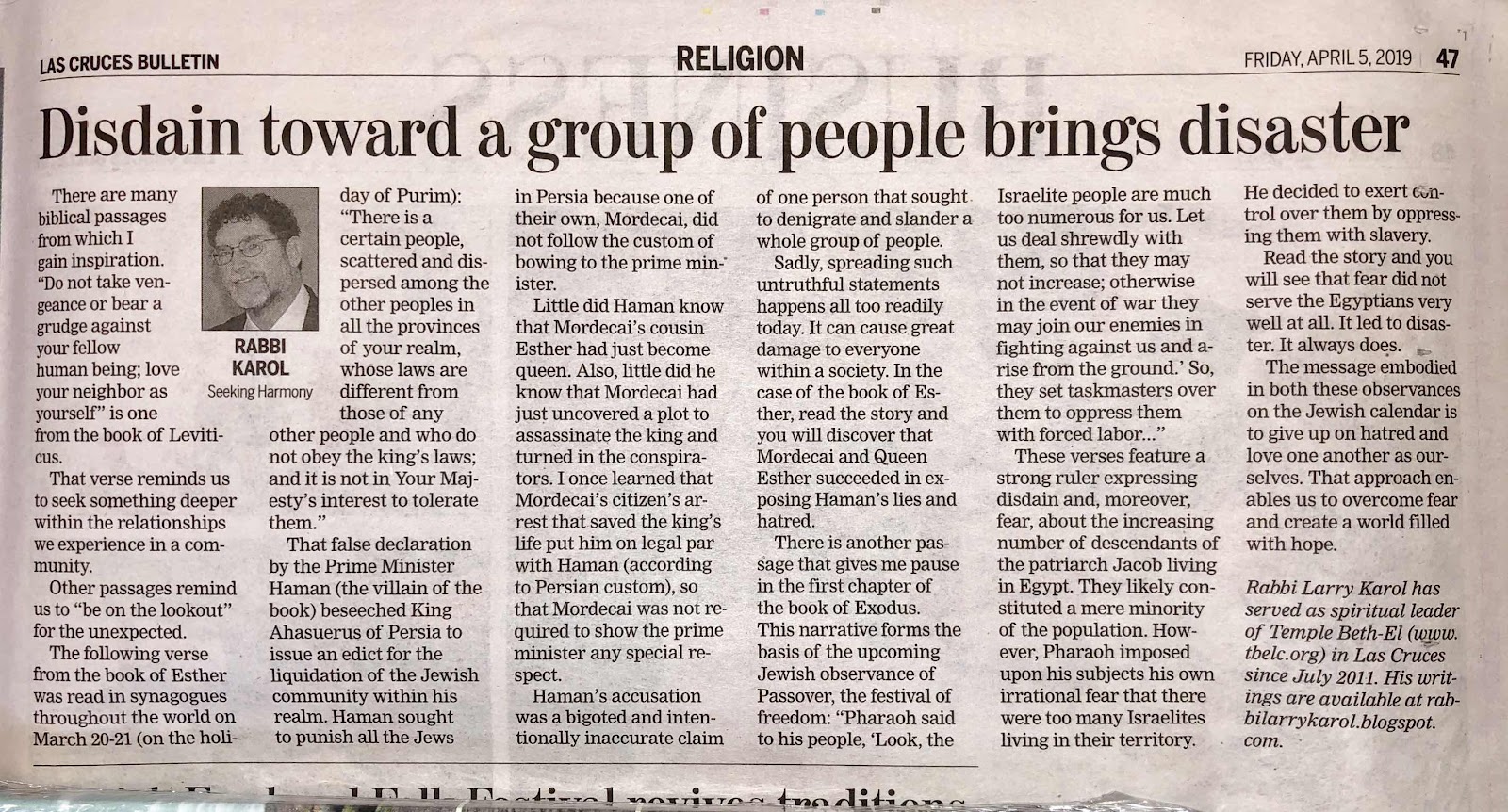
Saturday, April 6, 2019

Disdain toward a group of people brings disaster - Column for Las Cruces Bulletin April 5, 2019


   There are many biblical passages from which I gain inspiration.  “Do not take vengeance or bear a grudge against your fellow human being; love your neighbor as yourself” is one from the book of Leviticus.

    That verse reminds us to seek something deeper within the relationships we experience in a community. 

      Other passages remind us to “be on the lookout” for the unexpected. 

    This verse from the book of Esther were read in synagogues throughout the world on March 20-21 (on the holiday of Purim):  “There is a certain people, scattered and dispersed among the other peoples in all the provinces of your realm, whose laws are different from those of any other people and who do not obey the king’s laws; and it is not in Your Majesty’s interest to tolerate them.”

     That false declaration by the Prime Minister Haman (the villain of the book) beseeched King Ahasuerus of Persia to issue an edict for the liquidation of the Jewish community within his realm.  Haman sought to punish all of the Jews in Persia because one of their own, Mordecai, did not follow the custom of bowing to the prime minister. 

    Little did Haman know that Mordecai’s cousin Esther had just become queen. Also, little did he know that Mordecai had just uncovered a plot to assassinate the king and turned in the conspirators.   I once learned that Mordecai’s citizen’s arrest that saved the king’s life put him on legal par with Haman (according to Persian custom), so that Mordecai was not required to show the prime minister any special respect. 

      Haman’s accusation is still chilling to me.  It is a bigoted and intentionally inaccurate claim of one person that sought to denigrate and slander a whole group of people.        

    Sadly, the spreading of such untruthful statements happens all too readily today.  It can cause great damage to everyone within a society.   

      In the case of the book of Esther, read the story and you will discover that Mordecai and Queen Esther succeeded in exposing Haman’s lies and hatred. 

      There is another passage that gives me pause in the first chapter of the book of Exodus.  This narrative forms the basis of the upcoming Jewish observance of Passover, the festival of freedom: “Pharaoh said to his people, ‘Look, the Israelite people are much too numerous for us. Let us deal shrewdly with them, so that they may not increase; otherwise in the event of war they may join our enemies in fighting against us and a-rise from the ground.’ So they set taskmasters over them to oppress them with forced labor....” 

      These verses feature a strong ruler expressing disdain and, moreover, fear, about increasing number of descendants of patriarch Jacob living in Egypt. They likely constituted a mere minority of the population.  However, Pharaoh imposed upon his subjects his own irrational fear that were too many Israelites living in their territory.  He decided to exert control over them by oppressing them with slavery, a policy that the people dutifully and sadly accepted. 

    Read the story and you know that fear did not serve the Egyptians very well at all.   It led to disaster.   It always does.  

   The message embodied in both of these observances on the Jewish calendar is to give up on hatred and love one another as ourselves. 

   That approach will enable us to overcome fear and to a world filled with hope.      


Wednesday, March 27, 2019

Until we are all free, we are none of us free - Passover Column for El Paso Jewish Voice - April 2019

       Temple Beth-El’s Tanakh Study Group, which meets most every Wednesday, has been studying the book of Ezra, and we are about move into the book of Nehemiah.  Before that, we had completed a two-year study of the entire book of Isaiah. 

        The Jews who left their temporary homes in Babylonia, to where they had been exiled around the time of the destruction of the first Temple in Jerusalem, were elated at the possibility of returning to Judea to become a people in their land once again.  They saw their journey (around 538 BCE) as a second Exodus, leaving their captivity to travel to the promised land.   They were grateful that the Persians, who had conquered Babylonia, provided them with an opportunity to return home. 

      Once they arrived, they found that people who had not gone into exile held their motives under suspicion.  Eventually, the returnees were able to fulfill their wish of building a new Temple and reestablishing their society.   

      It wouldn’t be as before.   Some Jews remained in Babylonia.  These Jews in Judea, under the leadership of Ezra the Scribe, gathered for public Torah readings.   They heard about —and studied—the experiences of their people entering Canaan after wanderings in the wilderness, establishing the kingdom of Israel that, unfortunately, split in two after the death of King Solomon. 

      I wonder if they were saddened by the fact that their march to freedom had ended in division.    Psalm 133, the source for “Hinei Mah Tov/How good it is,” seems to express a longing for the two kingdoms, Israel and Judah, to reunite. 

      The Assyrian conquest of the northern kingdom, around 720 BCE, resulted in refugees from the north seeking safety in the south.  It wasn’t exactly a fulfillment of the wish of Psalm 133, but it did demonstrate that descendants of the people who had originally left Egypt together still saw themselves as family. 

      Jewish history includes all too many examples of divisions between people due to ideology and theology, where some groups see themselves as the only ones who are dedicated to God’s true message and the right approach to living as a minority in many countries, and as a majority in the State of Israel. 

      Passover/Pesach has its own way reuniting us. Through disagreements and challenges to our well-being, we gather at the Seder table to recount a story of moving from slavery to freedom, interpreting liberty according to our own perspective. 

       Emma Lazarus, author of “The New Colossus” poem associated with the Statue of Liberty, once stated what she considered to be an essential view of freedom: “Until we are all free, we are none of us free.”  

        It is incumbent on each of us, as the Haggadah says, to see ourselves as if WE were freed from Egypt, and to answer Emma Lazarus’ challenge of working for freedom everywhere.  

       May we address that task every day, inspired by the prayers, songs, readings, and rituals of Pesach.  


I was a slave...now I am free - column for the Temple Beth-El Las Cruces April 2019 Adelante Newsletter

On an ARZA Rabbinic Trip in January, 1966

   I was a slave. 
   Now I am free.
    What am I going to do with that freedom?
    I am going to choose work that I like to do, which will, in some way, bring me satisfaction, fulfillment and even joy.
I will wake up and look at the sun shining, or, if there is no sun, observe the clouds in all of their shapes and sizes.
I will try to make it possible to watch the sunset, and to marvel at the colors painted onto the sky as darkness begins to arrive.
I will read what I want to read, works that educate me, edify me, challenge me, and inspire me.
I will listen to music that I enjoy, but I will try to learn about music that moves other people as well.
I will sing what I want to sing, and, if I am given the gift, create music, perhaps with lyrics, that speaks to the essence of my soul.
I will consider how I was treated as a slave, and resolve to treat no one like that for any reason, be it a sense of renewed privilege, or a desire for revenge through exercising power over others.
I will remember how I helped my fellow slaves:  how I and others assisted all those who were unable to fulfill their assigned tasks, whether they were young, old, injured or in poor health due to the work conditions foisted upon them.
I will remember how the taskmasters looked at me with contempt and disdain, shouting at me words of derision, threatening me with punishment if I did not complete my quota for the day, declaring to me that I was nothing, and no one, undeserving of consideration.
I will remember how I viewed my taskmasters:  with anger and defiance, both touched with sadness that anyone could be so indoctrinated and brainwashed into thinking that I wasn’t human.
I will look around my community where I now live and ask myself:
How can I show consideration to my fellow human beings in any given situation?
How can I help and stand up for people whose life experiences have put them in dire straits?
How can I lift up people whose souls have been destroyed by others for the sake of power, greed, or bigotry?
How can I show appreciation to people who serve me in their work, giving them a momentary gift of gratitude that will enable them to make it through their day with a good feeling about themselves?
How can I join with others to create a world without exploitation and inequality?
How can I further mutual understanding and respect among people of different backgrounds?
How can I act with kindness and compassion, where doors too often close on opportunities to achieve personal well-being?
How can I learn from the times when I have been the object of bigotry, oppression, discrimination to assure that other people never have to face those obstacles to a safe and secure place in society?
   In every generation, says the Passover Haggadah, we should view ourselves as if WE went free from Egypt. 
   Once we were slaves; now we are free.
   We should never forget that for a moment. 


Saturday, March 23, 2019

Invocation for Temple Beth-El Las Cruces Board meeting - Purim’s Lessons - March 21, 2019

Eternal One, 

Creator and Sustainer of All,

Help to those in distress, 

Support to those targeted through hatred

Inspiration to those who seek to treat others with respect and love, 

Enable us to see the Divine Image in which every person was fashioned. 

Teach us to engage in dialogue even when it might seem impossible. 

Grant us the patience to sustain conversations 

to the point of finding common ground. 

Remind us that face-to-face discussions 

can turn misunderstandings into newly shared perspectives. 

Keep us far from accusations that have no basis

Distance us from information about any person 

that has no grounding in fact or reality.

Empower us to overcome barriers 

that assist assist the insidious spread of fear and animosity. 

Unite us in our resolve to build a community 

that reflects the vision of Your Oneness,

Where cooperation, compassion and partnership 

facilitate the formation of lasting bonds of relationship and friendship. 

Be with us, 

And walk alongside us in our work to make our sacred space

And this entire world 

A true Bayt-El, a house filled with Your presence. 

Amen 


Friday, March 15, 2019

Still...In My Image - D’var Torah for Vayikra 5779 - March 15, 2019

   The Eternal One called to Moses and spoke from the Tent of Meeting....and then hesitated. 

   “Moses,  I will command you about the sacrifices in good time.   I must teach you about the future.”

     Moses had been ready to take God’s instruction about ritual. He was taken aback.  “What future?  Whose future, Eternal One?”  

   “Not just the future of your people,” God said.   “The future of all humankind.”  

    “What do you see, my God?  After all we, the children of Israel, have been through, I want to know.”   Moses waited for God’s reply. 

     After a brief silence,  God’s words came to him in a whisper.

   “I am going to teach you to love all people as you love yourselves.  I will declare to you that you must see the oneness of you and your fellow human beings as a reflection of my Oneness.   I have already taught you that your hearts and hands should be open to the stranger and the poor.” 

     “In the distant future, there will be many nations in the world, and you and your people will be few in number compared to everyone else.  You will have my teachings as your guide, principles that you can share with the world.   I see moments when times of peace and calm in communities will be violently interrupted by attacks by certain individuals who believe they can speak for Me by using a deadly weapon to murder people who are different from them, people they don’t understand whom they have condemned to death in their minds and hearts.” 

    Mose was indignant.  “But, Eternal One, that action violates your commandments not to commit murder and not to bear false witness.” 

     “You have learned well, Moses. You speak rightly, and it is your voice that must echo throughout your generations to remind your people - and all people - to overcome the hatred in their hearts in order to see all people as My children - and your brothers and sisters.   One of your descendants will teach that every human being is a beloved creation because I made you all in My image.  Will you impress that on your descendants?  And Moses, you are one of the most humble people who will ever live.  Remind your people - and all people - never to see themselves as greater or better than anyone else and that they can do just that by walking humbly with Me and with each other.  

   Moses proudly proclaimed,  “I will pass on your teaching, so that my descendants will cry out and protest when people are violent with one another in words or deeds, needlessly disrupting or taking lives, due to unnecessary hatred in their hearts.” 

     God listened to the leader of the Israelites.  And God knew that Moses would make this come to be.  


   .