Friday, August 2, 2019
More learning...more wisdom! Reflections on #newcaje10 - August 2, 2019
Friday, July 19, 2019
Blessing all the people (A Modern Original Midrash) - D’var Torah - Parashat Balak - July 19, 2019
The prophet Balaam had been called by Balak, the King of Moab, to curse the Israelites, who were encamped in the desert.
He ascended the mountains nearby with the Moabite monarch, a vantage point that provided him with a view of the entire people.
But he knew that he was not in control of all of the words he would speak.
God had told him that he would only be able to say what God allowed.
Balaam told the King about this caveat, but Balak insisted that Balaam fulfill his mission.
Before he began, Balaam stepped away, telling the King that he needed a private moment.
“Balaam!” God called.
“Yes, Eternal One, I hear You.” Balaam was fearful, even though he had already heard God’s instruction.
“What are you doing? Go ahead - go back and speak.”
“I still want to curse them, God, but I know You won’t let me do that. So, if I bless them, whom will I be blessing?”
God, as much as God could be, was puzzled. “What do you mean?”
Balaam replied, “I have heard stories about the Israelites. Moses is a humble, spiritual and powerful leader that this people has followed for many years. Some of the people have doubted him. Others rebelled against him. You give them food and provide them with water in the desert. They should be grateful. Do they all really deserve blessing?”
God was a bit startled, but answered forthrightly. “The stories you have heard are true. They have worn Moses down too many times. They have worn Me down, too. Even when I wanted to give up on them, Moses wouldn’t let me. So here we are, tied together in an eternal covenant, with rules engraved in tablets of stone and in the teachings of leaders to the people, and parents to children. They were slaves, and now they are free, and at least most of them are grateful.”
Balaam was moved by God’s commitment to this people. And then he asked, “God, do you love them?”
God was pleasantly surprised by the question. “Why, Balaam, yes, of course I do. Just because they have doubted me doesn’t mean I don’t love them, and I feel their love in return.”
Balaam posed one more query. “God, do they love each other? Are they a people that will teach about what it means to love one another?”
God replied, “Why, Balaam, does that matter to you?”
Balaam responded, “Because I was called here due to the hatred of a King that wants to see this people cursed to the point of extinction. If all I can do is bless them, I want to bless a people that will dispel hatred and spread greater respect and love that will end the conflicts that plague us all too much in this world.”
God reassured the foreign prophet, “You have nothing to worry about, Balaam. I will guide them, inspire them, direct them, and teach them from one generation to the next. They will learn from one of their teachers many centuries from now, ‘What is hateful to you, do not do to your neighbor.’ They will see their experience as slaves as a reason to treat the stranger with compassion. Is that enough of a reason for you to bless them rather than utter curses that will destroy them?”
Balaam quietly replied, “Yes, Eternal One. If my blessings will begin a process of bringing conflict to an end in the distant future, I will bless them. Can you guarantee that this people will be moved by my blessing in the generations to come, enough to spread love, respect and hope?”
God replied, “Even after all I have been through with the Israelites, I have faith in them as they believe in Me.”
“All right, I am ready.” Balaam walked back to Balak the King, and began uttering his prophecy.
“How fair are your tents, O Jacob, Your dwellings, O Israel - MAH TOVU OHALECHA YA-AKOV, MISH-K’NOTECHA YISRAEL.”
Thursday, July 18, 2019
Invocation - Temple Beth-El Las Cruces Board Meeting on July 18, 2019 - Understanding and Peace on the Earth and the Moon
Eternal One,
Creator and Sustainer of us all,
Activate our wonder
So that we can marvel in achievements and discoveries
That have revealed crucial information about
The origins of our solar system
The connections between the earth and the moon,
And our place in this wide and amazing universe.
Enliven our curiosity so that we will seek more knowledge
About the unity within creation
Not only in the heavens
But here in our world.
As we have conquered the fear of the unknown by
reaching for the skies,
May we overcome the temptation to approach people from different origins and backgrounds only with fear.
May our arms, eyes and ears be open
To the stories of our fellow human beings
So that we can recognize the resonance of their narrative
With our own story
That traces how we came to live in this country and community.
May we be steadfast in our own positions and beliefs,
And may we also defend the rights of those who hold opposing viewpoints to our own
With the hope that, somehow, some way, we might be able
To find a path towards compromises that can begin to solve the challenges we face.
Remind us that loving our neighbors and the stranger as ourselves
Requires a rejection of bigotry and prejudice in whatever form they may take.
Bind us together as one human family in ways that will
Lead us to true understanding and lasting peace.
Amen.
Friday, July 12, 2019
Everyone’s life is worthy of a trading card - Column for Las Cruces Bulletin - July 5, 2019
Patience, Humility and Hope - D’var Torah - Parashat Chukat - July 12, 2019
I have closely followed the American space program beginning with the missions of Gemini 7 and Gemini 6 in December 1965. I remember the graphics in Time magazine illustrating their combined flight that achieved the milestone of the first rendezvous in earth orbit between two manned spacecraft. The photographs shared after the flight of the two Gemini capsules flying close to one another was impressive. Successful exploration of space was the result of ingenuity, insight, teamwork, and patience. The Mercury and Gemini programs represented the first steps to accomplish President John F. Kennedy’s goal to land astronauts on the moon by the end of the 1960s.
Public Television aired, earlier this week, their series entitled “Chasing the Moon” to mark the 50th anniversary of the Apollo 11 moon landing. Each program chronicled the gradual progress of the manned space program, with flights that provided the building blocks and skill and hardware development necessary to assure, as much as possible, a safe moon landing.
The second episode of the series included what I would consider to be the most detailed portrayal of the ill-fated Apollo 1 mission. Astronauts Gus Grissom, Ed White and Roger Chaffee died when a fire broke out in their Apollo capsule cockpit during a test of communications and other systems on January 27, 1967. I was watching television that night when the network interrupted regular programming with the announcement of the fire and tragic loss of life. The details of what happened and photos of their charred capsule were shared in the days and weeks that followed. The commentary during the “Chasing the Moon” episode discussed the attitudes that may have led to the tragedy. Impatience and arrogance by those who created and produced the Apollo capsule led them to assume that everything would be fine, because everything had always been fine before. No one questioned the risk of maintaining a 100% oxygen atmosphere, in a crew cabin filled with flammable materials, during the test that ultimately took the astronauts’ lives. No one seemed to consider the possibility that a hatch that opened into the capsule, instead of one that opened out, would prevent workers outside the spacecraft from being able to offer crucial help in case of an emergency. Later that year, I visited the graves of two of the Apollo 1 astronauts at Arlington National Cemetery. While the astronauts knew of the dangers of space flight, the consequences of that night lingered for many months, as NASA worked with the companies involved to ensure the safety of the revamped Apollo capsule.
As I listened to the newly-told story of Apollo 1, I thought of Moses and Aaron in this week’s Torah portion. God told Moses to speak to a rock to produce water for the people, who were, once again, complaining that they had been brought into the wilderness to die. Once before, God had told Moses to strike a rock to produce water. The intensity of the tumult among the people wore Moses’ patience thin. He had always given God credit and gratitude for all of the divine acts that had preserved the Israelites on their journey. This time, the usually humble leader seemed to change his tune. He proclaimed over the shouting of the Israelites, “You rebels, shall we get water from this rock?” Then he struck the rock, yielding the desired stream of water for the people to drink.
God immediately told Moses and Aaron that they would not lead the people into the land of Canaan. We might think that Moses and his brother deserved at least a little mercy in the face of this impatient people. What they learned is that every word and action counts, and that letting down one’s guard, even once, can have dire consequences for the moment and for the future. Moses’ lack of patience led him to portray himself to the people as having divine power. He violated one of the central principles of his service to God and to the Israelites - that he was their human guide, following God’s direction along the way. He probably realized that it was time to appoint Joshua as his successor and to train him to be humble, patient, steadfast and always optimistic.
The lessons learned from the Apollo 1 fire ultimately led to the success of the Apollo missions to the moon, which featured 6 moon landings along with the crew in space and on the ground overcoming seemingly insurmountable odds during the flight of Apollo 13.
In our own lives, there may be challenges that arise which require us to be patient, humble, and hopeful, and which might call on us to recognize the potential partners nearby who can share our concerns and lighten our burdens. May we accept, with open arms, the support and help that comes to us, so that we will proudly and safely reach our destination, whatever it may be.
Friday, June 14, 2019
"Blessings above and below" - D'var Torah - Parashat Naso - June 14, 2019
Most days, I find myself looking to the sky
around the time of sunset. Even
cloudless evenings feature a colorful glow on the horizon after the sun has
completed its descent. For me, though,
it’s the clouds, their ever-changing shapes, and the vast array of colors that
ensue that make the sunset views to which we are treated so spectacular. When I am not involved in a meeting or other
activity at days’ end, I keep my eyes trained on the western sky. I usually photograph the sunsets which I
consider to be most impressive, sometimes more than once. I know
that many of us appreciate the blessings which creation bestows on us each
night, vistas that illustrate the diverse wonders in our world. 
Here is a link to a performance of the song "You Can Open Your Eyes"
Larry Karol sings "You Can Open Your Eyes"
And here are the lyrics
You Can Open Your Eyes (L. Karol - March, 2001)
Some days are so hard that we look to the night
As our protection when we have no strength left for the fight
We refuse to believe that we can go on
And we wonder when the night and the pain will be gone
CHORUS: The clouds in the distance roll the darkness from the light
When you wake up, the sun will still rise, it's all right - You can open your eyes
It may be people we know, the situations we face
We need patience to answer with wisdom and grace
It takes courage to live, uncertain of what will be
There are days when the night is all we can see - CHORUS - You can open your eyes
A brilliant dawn is breaking as the ocean kisses the shore
Even through the haze, there is promise in store
So rest for a while, let your mind be still - There are hills to climb and dreams to fulfill
Your aspirations will guide your work until it's done
May you walk with hope when each day has begun - CHORUS
You can open your eyes
When you wake up, the sun will still rise, it's all right - You can open your eyes
Thursday, June 6, 2019
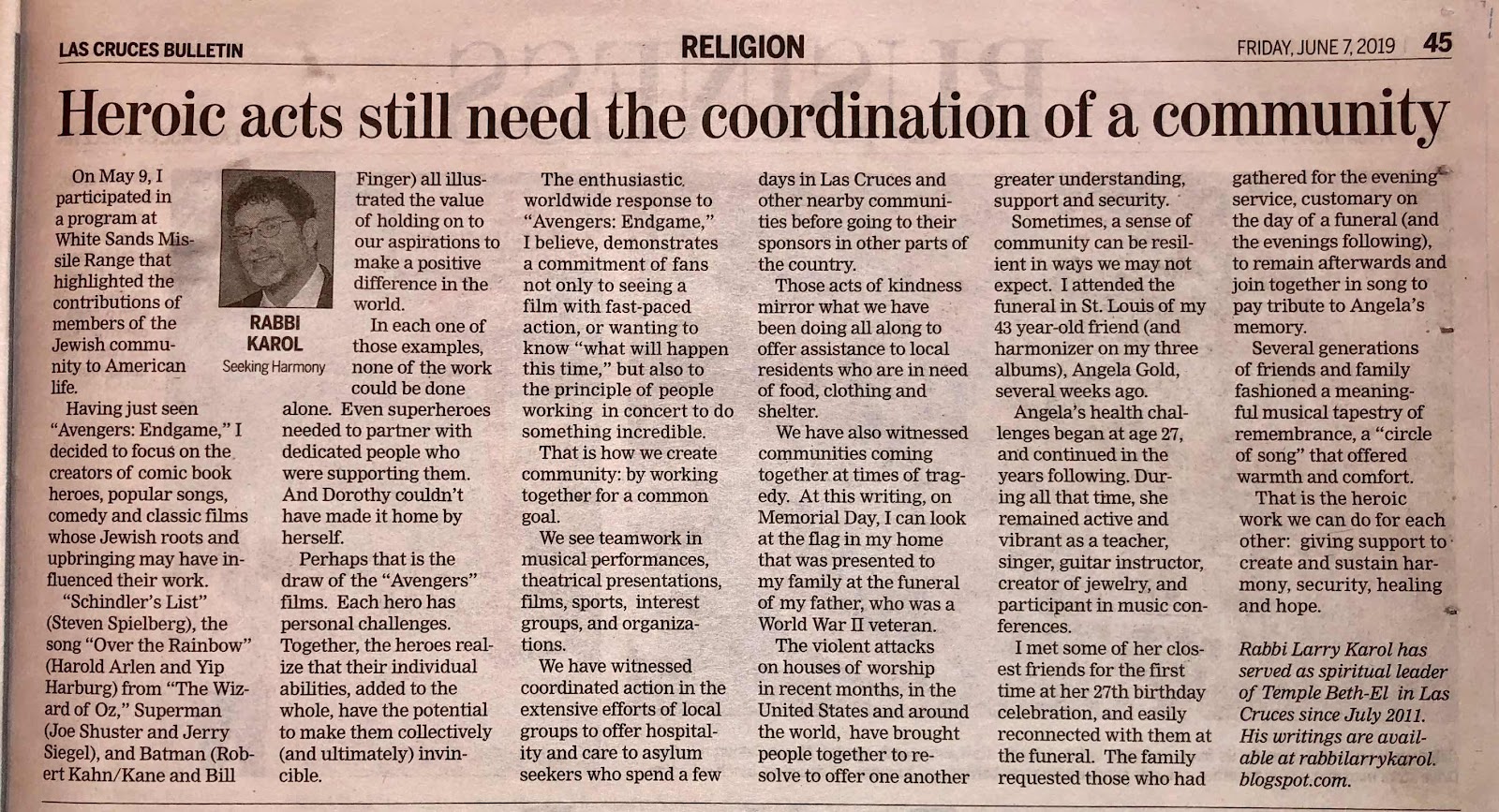
Heroic acts still need the coordination of a community - Column for Las Cruces Bulletin - Friday, June 7, 2019
On May 9, I participated in a program at White Sands Missile Range that highlighted the contributions of members of the Jewish community to American life.
Having just seen “Avengers: Endgame,” I decided to focus on the creators of comic book heroes, popular songs, comedy and classic films whose Jewish roots and upbringing may have influenced their work.
“Schindler’s List” (Steven Spielberg), the song “Over the Rainbow” (Harold Arlen and Yip Harburg) from “The Wizard of Oz,” Superman (Joe Shuster and Jerry Siegel), and Batman (Robert Kahn/Kane and Bill Finger) all illustrated the value of holding on to our aspirations to make a positive difference in the world.
In each one of those examples, none of the work could be done alone. Even superheroes needed to partner with dedicated people who were supporting them. And Dorothy couldn’t have made it home by herself.
Perhaps that is the draw of the “Avengers” films. Each hero has personal challenges. Together, the heroes realize that their individual abilities, added to the whole, have the potential to make them collectively (and ultimately) invincible.
The enthusiastic worldwide response to “Avengers: Endgame,” I believe, demonstrates a commitment of fans not only to seeing a film with fast-paced action, or wanting to know “what will happen this time,” but also to the principle of people working in concert to do something incredible.
That is how we create community: by working together for a common goal.
We see teamwork in musical performances, theatrical presentations, films, sports, interest groups, and organizations.
We have witnessed coordinated action in the extensive efforts of local groups to offer hospitality and care to asylum seekers who spend a few days in Las Cruces and other nearby communities before going to their sponsors in other parts of the country.
Those acts of kindness mirror what we have been doing all along to offer assistance to local residents who are in need of food, clothing and shelter.
We have also witnessed communities coming together at times of tragedy. At this writing, on Memorial Day, I can look at the flag in my home that was presented to my family at the funeral of my father, who was a World War II veteran.
The violent attacks on houses of worship in recent months, in the United States and around the world, have brought people together to resolve to offer one another greater understanding, support and security.
Sometimes, a sense of community can be resilient in ways we may not expect. I attended the funeral in St. Louis of my 43 year-old friend (and harmonizer on my three albums), Angela Gold, several weeks ago.
Angela’s health challenges began at age 27, and continued in the years following. During all that time, she remained active and vibrant as a teacher, singer, guitar instructor, creator of jewelry, and participant in music conferences.
I met some of her closest friends for the first time at her 27th birthday celebration, and easily reconnected with them at the funeral. The family requested those who had gathered for the evening service, customary on the day of a funeral (and the evenings following), to remain afterwards and join together in song to pay tribute to Angela’s memory.
Several generations of friends and family fashioned a meaningful musical tapestry of remembrance, a “circle of song” that offered warmth and comfort.
That is the heroic work we can do for each other: giving support to create and sustain harmony, security, healing and hope.