Thursday, April 2, 2020
Words of Torah - The Fire Inside....Still Burning - Parashat Tzav - April 2, 2020
Friday, March 27, 2020
Words of Torah - Parashat Vayikra - March 27, 2020
WORDS OF TORAH - March 27, 2020 - Rabbi Larry Karol
Shabbat Shalom. I hope everyone is well and safe. Our hearts go out to those whose health has been challenged, and to the family members of those who have died in recent weeks.
**********************
If we were to put our life experiences together, and tell the stories about those experiences, we might find episodes that bear some resemblance to what is happening now.
Our collective memories begin in the 1920s. Think about the major challenges which the people in our country and around the world have faced over the last century. And consider the recent history of the worldwide Jewish community, facing prejudice, discrimination, extermination, wars, and concerns about how we can survive and thrive.
The Torah portion for this week, VAYIKRA, begins the book of Leviticus, which outlines the particulars of sacrifices (of designated animals and grain) offered in the Tabernacle in the wilderness, and, later, in the Temple in Jerusalem.
The ancient Israelites knew that the word for sacrifice/offering in Hebrew, KORBAN, meant “to draw close,” that is, close to the Eternal One.
One of the major recurring triumphs of Jewish history is the ability to adapt to new circumstances. When the Romans destroyed the Second Temple in the year 70, the rabbis had already developed a way for Judaism to preserve continuity without a central place to bring sacrifices and to be in the presence in God.
The rabbis realized that the prayers they had been reciting in synagogues, even while the Temple stood, could be their salvation, and that those meditations also brought them close to their Creator, no matter where they lived.
When Jews moved to new communities over the last two millenia, or were forced to relocate, they took their customs, practices and melodies with them and created synagogues in their new towns of residence. In those places, they found ways to hold their communities together and and to recognize God’s presence with them.
We value being in each other’s presence, hearing our voices united in song and prayer, study, sharing ideas, and creating a communal identity.
We are still doing that even now, amid our current challenges, because we, like the Jews before us, are finding ways to adapt. Telephone calls have been with us for a long time. Emails emerged more recently, as did texting. Now, services streamed on Facebook (which still enable us to draw close to God as a community) and meetings and study sessions on Zoom are the fruits of our willingness to learn and adapt.
We have inherited an incredible tradition of creating bridges to each other, even in difficult times, with God as our inspiration and as a source of strength and ingenuity.
In these unusual times, may we continue to stay together and inspire one another.
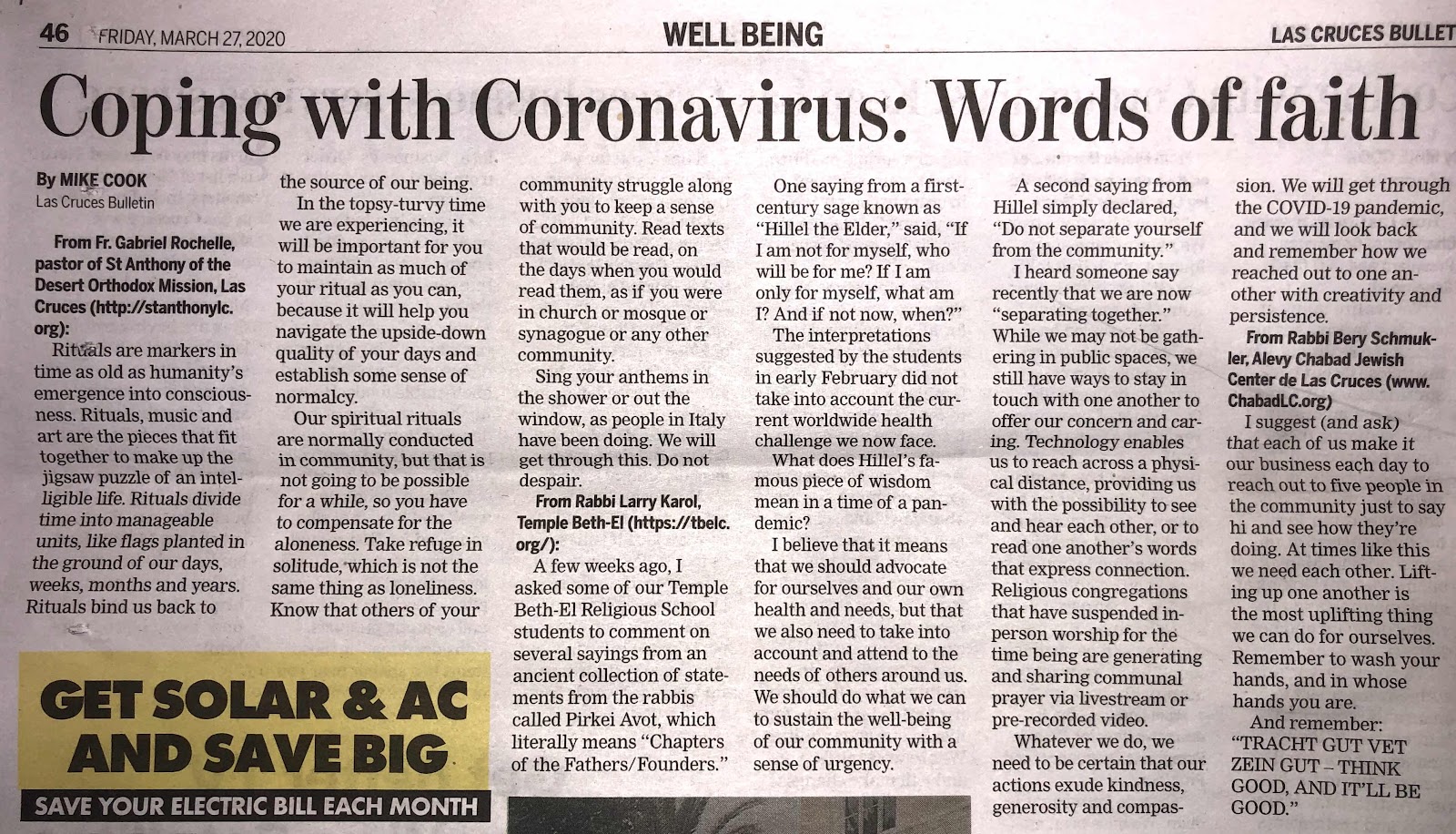
Coping with Coronavirus - Words of Faith - my contribution to this column - Las Cruces Bulletin - March 27, 2020
A few weeks ago, I asked some of our Temple Beth-El Religious School students to comment on several sayings from an ancient collection of statements from the rabbis called Pirkei Avot, which literally means “Chapters of the Fathers/Founders.”
One saying from a first century sage known as “Hillel the Elder” said, “If I am not for myself, who will be for me? If I am only for myself, what am I? And if not now, when?”
The interpretations suggested by the students in early February did not take into account the current worldwide health challenge we now face.
What does Hillel’s famous piece of wisdom mean in a time of a pandemic?
I believe that it means that we should advocate for ourselves and our own health and needs, but that we also need to take into account and attend to the needs of others around us. We should do what we can to sustain the well-being of our community with a sense of urgency.
A second saying from Hillel simply declared, “Do not separate yourself from the community.”
I heard someone say recently that we are now “separating together.” While we may not be gathering in public spaces, we still have ways to stay in touch with one another to offer our concern and caring. Technology enables us to reach across a physical distance, providing us with the possibility to see and hear each other, or to read one another’s words that express connection. Religious congregations that have suspended in-person worship for the time being are generating and sharing communal prayer via livestream or pre-recorded video.
Whatever we do, we need to be certain that our actions at this time exude kindness, generosity and compassion. We will get through the COVID-19 pandemic, and we will look back and remember how we reached out to one another with creativity and persistence.
Psalm 133, verse 1, proclaims: “How good and how pleasant it is when people dwell together in unity.” We can maintain a sense of unity by filling in the spaces that temporarily keep us apart with love and hope that comes from the depths of our hearts.
May we know healing and safety in the days to come.
Thursday, March 19, 2020
Invocation - TBE Las Cruces virtual Board Meeting -03192020
Invocation –
Temple Beth-El Board meeting
March 19, 2020
Eternal God,
As we approach the beginning of our festival of freedom,
We may feel that we are confined in ways we may not have
imagined.
We may feel that we are in the wilderness, searching for direction
that will lead us to find each other.
Grant us the knowledge that will enable us to master new
modes of creating connections and maintaining relationships across the space between us.
Grant us the wisdom to fashion effective lines of connection
between our community members, so that we can offer
assistance and support when needed.
Grant us patience with ourselves and with each other as we
walk this path of discovery.
We learn from the Talmud that all Israel is connected, one
person to another.
KOL YISRAEL AREVIM ZEH BAZEH
Our physical separation cannot keep us from the ties that bind
us together as a congregation.
Temple Beth-El, our House of God, is taking on a new form.
May we be builders of this sanctuary of caring, hope and love
Friday, March 13, 2020
A Day of Rest - On Ki Tisa - 03132020
A DAY OF REST
Rabbi Larry Karol
March 13, 2020
“It is a sign for ever
between me and the people of Israel.”
So says the book of Exodus about Shabbat.
How - or of what - is Shabbat a sign?
It is a sign that we are creators, like God, who need to rest.
It is a sign that hard work has its rewards, including rest.
It is a sign that productivity does not always have to be the goal of our lives.
It is a sign that holiness can come to us when we declare that we are not slaves to time, or to space, or to our routines.
It is a sign that stopping the flow of our lives during the week can enable us to see ourselves and others better.
It is a sign that stepping off of the treadmill of life can give us an opportunity to look around at the world and appreciate its bounty and beauty.
It is a sign that we sometimes need a day off to heal the hurts of recent days that have passed.
It is a sign that sometimes we need a day off to celebrate our accomplishments and triumphs.
It is a sign that we should take a day to replenish our energies for the challenges and celebrations yet to come.
It is a sign
FOREVER.
Thursday, February 20, 2020
Fairness, Justice and Balance - Invocation for Temple Beth-El Las Cruces Board Meeting - February 20, 2020 (for Parashat Mishpatim)
Eternal God,
Lawgiver, Guide, Creator,
You have provided us with a roadmap to integrity
In Your Torah.
We learn to show fairness and to promote justice
without preference.
We are instructed to show consideration and respect to those people
Who may oppose us and hate us,
Even when our impulse might be to rescind our kindness
When we have an opportunity to show it.
We are directed to remain distant from anyone who would levy a false
Charge against an innocent person,
Because through our silence or our verbal assent to the those
Who would invent such untruths,
We become accomplices in their crime, whether it is discovered or not.
The Torah demands that we refuse to take bribes, which can
Turn the tables of justice so that a guilty person can escape scrutiny or eventual punishment.
And we know, Our true judge, that You would want us to remove our support from anyone who would take a bribe to that immoral and illegal end.
As members of a greater community, we have taken to heart your command to treat the poor and the stranger with compassion and with generosity, having been strangers in so many lands in which we have lived, facing difficult conditions and seeking to overcome threats to our very well-being.
So now, as we look towards the future, seeking to sustain goodness and holiness in our world, give us hope and strength so that our steps will be firm and our vision far-reaching to spread throughout humanity righteousness, acceptance, and love.
Thursday, February 6, 2020
Remembering and Honoring Generations Past - Column for the Las Cruces Bulletin - February 7, 2020
The woman in the photo looked like the years had taken a toll on her, but there was special spark in her eyes. The text on the back of the photo noted that the year was 1926.
The rest of the writing was in Yiddish, the language spoken by Jews in Eastern Europe. Yiddish is written with Hebrew letters. Some of its words come directly from Hebrew, while others derive from German.
Some of my cousins and I were looking at this photo at a gathering after my mother’s funeral in 2004. We could read the woman’s first name inscribed on the back of the photo: Hene (Chanah in Hebrew, Hannah in English).
The last name was eluding us until I examined it more closely. I realized that it read “Karol.” We knew then, for certain, that we were looking into the face and eyes of our great-grandmother, who lived in Lithuania, and may have died soon after the photo was taken.
In the 1960s, I was first learning about the Holocaust, the systematic extermination by the Nazis of 11 million people, including six million Jews, in Europe during World War II. My parents told me that they didn’t know of any relatives who were victims of the Holocaust.
I thought that was true until my exploration on a genealogical website connected me with a woman living in Jerusalem who had left Lithuania in 1991. Via email, she told me that she was also a descendant of the Karols from one particular Lithuanian town. We were distant cousins.
It was the first time I realized that I had relatives who had remained in Europe during and after World War II. I would imagine that there were family members who died there as well, perhaps at the hand of the Nazis.
I am not sure what life was like for Hene Karol in Lithuania, but it definitely wasn’t easy.
About a year ago, my wife Rhonda and I attended a performance of “Fiddler on the Roof” in Yiddish in New York City, a production directed by Academy Award winner Joel Grey.
I imagined, while watching and listening to the songs and dialogue presented in the language of our Eastern European forbears, that the musical approximated the life of my ancestors: simple, difficult, and marked with moments of joy and celebration.
The Karols’ Jewish community, like others nearby, may have endured attacks like the one portrayed in the wedding scene in “Fiddler on the Roof.”
Those demonstrations of violence and murder came to be known as pogroms. They were nothing but a baseless outpouring of pure hatred and fear.
Tragically, the Holocaust took that earlier violence and hatred to an unimaginable extreme.
On Monday, January 27, 2020, I watched the live stream of the commemoration of the 75th anniversary of the liberation (by the Soviet Army) of the survivors of Auschwitz-Birkenau, the largest Nazi concentration and death camp, located in Poland. From my living room at home, I joined in reciting the traditional mourner’s prayer.
There have been survivors of Auschwitz and other concentration camps among my congregants throughout my rabbinate. Their persistence and their faith have always been an inspiration to me.
To carry on their legacy, and that of my family, I will continue to do all that I can, along with partners throughout the community, to combat hatred and to preserve freedom and peace in our precious world.