Wednesday, June 17, 2020

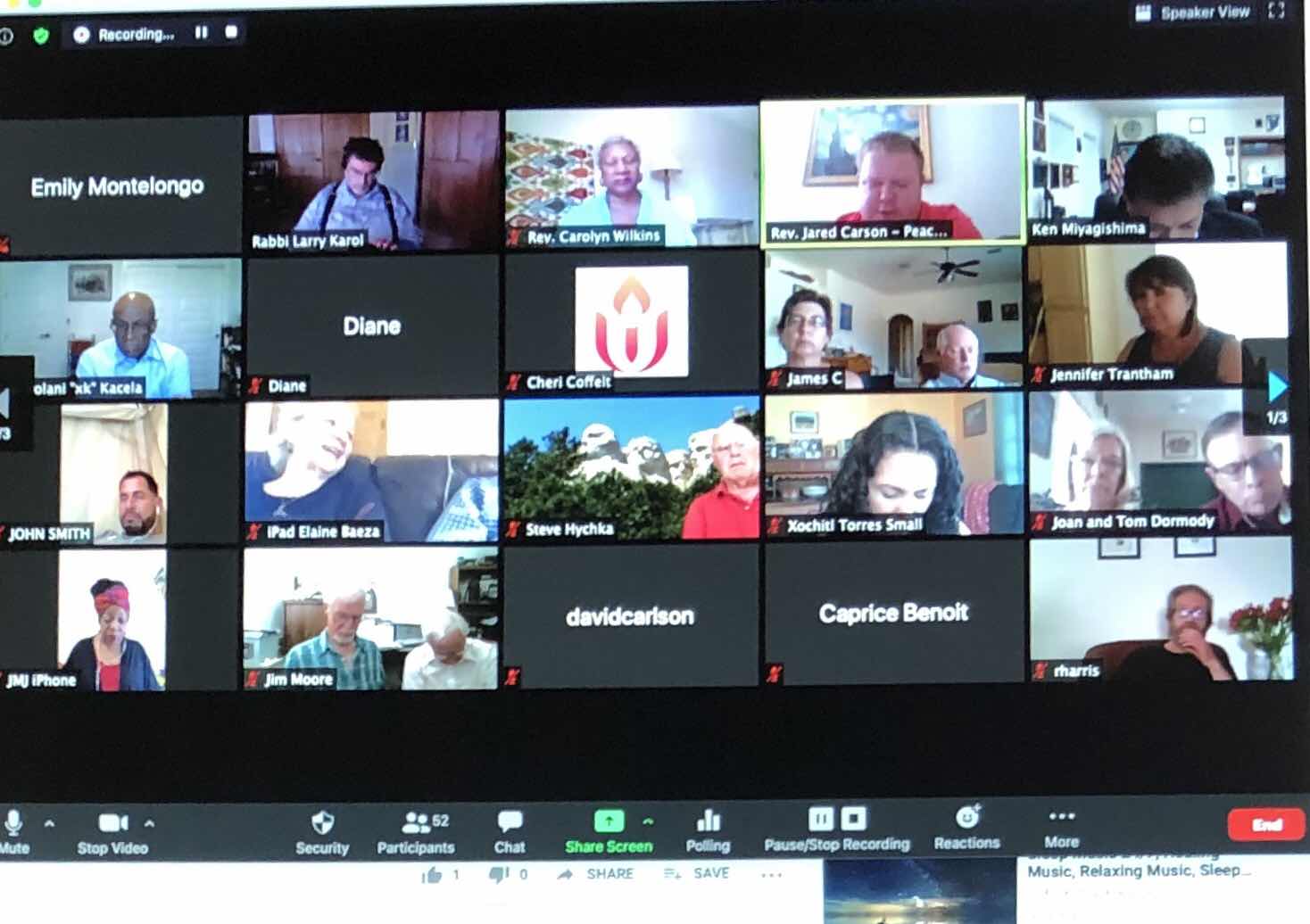
Invocation - Temple Beth-El Las Cruces Board meeting on June 17, 2020 (the concluding Board meeting of my active congregational rabbinate)

Eternal One,

Source of wisdom,

Wellspring of insight, 

As our ancestors were challenged

To adopt an attitude of optimism and courage

So that they could “go up” to a promised land

Let us now go up. 

Let us go up to new opportunities

Let us rise to the pinnacle of our creativity 

Let us aspire to greater ingenuity 

Let us ascend to a vantage point

that will enable us to see more clearly

our present and our future

Let us grow towards greater understanding

of ourselves and one another

Let us navigate the difficult paths that could separate us

So that we can come together in a place of unity

Let us overcome our fear of the heights of uncertainty

So that we can move forward on our journey with confidence and fortitude. 

Let us extend our spiritual reach to the heavens

Where Your peace reigns, Eternal God,  

And may we bring that peace down to our community 

So that harmony will envelop us

And your love will suffuse our souls.  

Eternal One, 

Source of hope, 

Wellspring of strength,

Let us go up. 


Sunday, June 14, 2020

Seeing the face of God - Remarks at Las Cruces NM Interfaith Virtual Peaceful Demonstration on June 14, 2020


“To see your face is like seeing the face of God.”

    We should be saying these words frequently, to every person we meet, even when our encounters may seem to pit us against one another. 

      This phrase was spoken by the biblical patriarch Jacob to his brother Esau. 

      Jacob thought that Esau was coming to kill him, to take revenge for all that Jacob had done to his brother through dishonesty and deceit so many years before. 

     “To see your face is like seeing the face of God.”

     Esau was coming to greet his brother with an entourage of 400 men.  This was nothing unusual for him.  Jacob didn’t know that Esau wasn’t planning to attack him.  When Esau saw his brother Jacob for the first time in many years, all he wanted was a reunion, a peaceful and hopefully face-to-face meeting.  He was looking forward to forging a new relationship.   It may be that Esau had not forgotten what his brother had done to him in the past.  It was just that he realized that they were brothers, and that they needed to be together again. 

      “To see your face is like seeing the face of God.” 

    Do we believe that every member of the family of humanity is created in the image of God, a spiritual template that enables us to show respect, to give support, to offer compassion, to extend our hearts in love, and to make peace with one another? 

      “To see your face is like seeing the face of God.” 

     God’s image does not come in one hue.  A spiritual image does not have color.   But external color has been a source of division.  Some human beings have not included people of color among those created in God’s image.  They have viewed them with fear, approaching them with a need to exert power and control over them, to buy and sell them, to try to proclaim to them that there is one culture in which they are not allowed to participate, creating a context where that difference leads to discrimination in housing, work, health care, and community and personal safety, and where calling out those areas of inequality is viewed with contempt and disdain. 

    “To see your face is like seeing the face of God.”

     This has happened too many times in human history.   It needs to stop.   Looking in to someone’s face, listening to their stories, empathizing with what is in their heart based on their experiences, that is what God would want us to do. 

      “To see your face is like seeing the face of God.”

     Can we truly recognize God’s presence in one another?  If we could, there would be equal treatment for all people.  There would no longer be suspicion, because, even with diversity, we could see God’s presence underneath that difference.  We would realize that unnecessary violence against one person of color is violence against every human being and against God.    We would understand that until everyone truly knows freedom, none of us are free.  We would finally fathom that if there is injustice experienced by some people, there is not yet justice for us all. 

      “To see your face is like seeing the face of God.” 

    We need to look harder into one another’s faces and hearts, and join together, hearing stories of trauma, making new narratives of cooperation and hope that will lead to changes in policy and attitudes that will enable our nation to make equality more real and true than ever before.  

       Only then will we see the face of God in one another.


Friday, June 12, 2020

“To stay or go? How do we know?” D’var Torah for Parashat B’ha-a-lot’cha - June 12, 2020

How do we know when it’s time to make a move...or a change? 

How do we know when it’s time to “stay put,” to be committed to where we are and to what we are doing at a given moment? 

  Most of us have had times in our lives when we did remain somewhere, because of a desirable job, a livable city or town, or, perhaps, because it was simply the best choice at the moment not to move.   

    There may have been other times when we realized that we should try to make a change.   The job might have become less desirable.  The city may no longer have offered us the connections, friends, opportunities and culture that we craved.    Or, we might have reached a point of restlessness that led us to test out ability to make a transition to new pursuits.  

      What is it that tells us to stay or to go?  We often just know for ourselves what we should do, if we have the wherewithal to do it.  It might be that we have friends, mentors and confidants who are able to sense our need to spread our wings and grow.  Those same people might be the ones who see us so content and fulfilled where we are that they might counsel against a change. 

      The Torah reading for this Shabbat, B’ha’alot’cha, from the book of Numbers, identifies the beacon that guided the Israelites in the wilderness.   

       We might think that the decisions for a change of location for the Israelites would certainly have emerged from a conversation between God and Moses...

     But not exactly in this case.    The direction did come from God, but it was in the form of a visible sign that all the people saw at once.   Here is the description from Numbers, Chapter 9: 

      “On the day that the Tabernacle was set up, the cloud covered the Tabernacle, the Tent of the Pact; and in the evening it rested over the Tabernacle in the likeness of fire until morning. It was always so: the cloud covered it, appearing as fire by night. And whenever the cloud lifted from the Tent, the Israelites would set out accordingly; and at the spot where the cloud settled, there the Israelites would make camp. On a sign from the Eternal they made camp and on a sign from the Eternal they broke camp.”

      That sounds so easy.   All the people had to do was to look up.  Whether it was day or night, they would know if they were supposed to move as a community or remain in place.  

     We know that the Israelites didn’t make it easy for Moses or for God.  This Torah reading includes an instance of new complaints about what was being provided for them to eat as they journeyed away from Egypt and towards their promised land.  

     In our lives, we know that change can be difficult.  A widely-used stress inventory cites the following experiences, among others, as adding to the stress we might be feeling at a particular time: moving to a new city, retirement, losing a job, shifting one’s careers, redefinition of job responsibilities, illness, the death of a loved one, beginning or completing an educational endeavor, and outstanding personal achievement. 

     I find it fascinating and curious  that there are positives mixed in with the negatives on this stress scale. 

      I want to share with you one moment from my life when reaching a positive goal led me to feel anxious and concerned. 

      I was in my concluding year at Hebrew Union College-Jewish Institute of Religion in Cincinnati.  I had just completed my research for my rabbinic thesis on the career of Rabbi Abraham Feldman, who served in Hartford, Connecticut for 50 years.    My next step was to compose the text for my thesis based on what I had discovered about Rabbi Feldman’s life and work. 

      At that point, I should have felt relieved and accomplished that I was ready to write.    I didn’t. 

      That night, I couldn’t sleep.  I left my dorm room and walked down the hallway.  One of my classmates saw me from his room and said to me, “Did you hear what happened?”  I said, “No, I was sleeping.”  He gave me the news.   “John Lennon was shot in New York City and died from his wounds.”    

      I was speechless.   The response to Lennon’s death over the next few days demonstrated how much people saw him and the best messages that he conveyed in his music as a beacon for their lives.    

       The murder of John Lennon affected many people, including me.  He had just released his new album, Double Fantasy. At that point, we had to consider his life’s work complete.  In the decades that have followed, his music continues to speak out in ways that we may not have been able to imagine back then.   John Lennon had already, at that point in his life, created a lasting legacy. 

      I went back to my room after my classmate told me what happened. When I thought again about my rabbinic thesis, I knew that I had to finish what I started.   I was at a crossroads that demanded that I not get stuck.  I need to take action.  

     I began writing the next day.  I turned in my completed thesis on March 9, 1981, five years to the day before the birth of our son Adam.   

       The events of December 8, 1980, one tragic for one of my favorite musical performers, and, the other, personal and creative, taught me how important it is to enjoy the journey, both while staying in place and when taking on new responsibilities or a new position.   Either way, I knew that it was crucial that I feel fulfilled and renewed.  

      We may never truly know exactly what leads us to stay or go, even when we attribute those decisions to our own instinct or to the advice of people in our lives whose judgment we trust.  

       But the signs are waiting for us to simply take a look and follow their guidance.   May we always be able to find that cloud by day, or fire by night, that will take us to where we need to go.  


Coming back - thoughts on the effects of COVID-19 (and its persistence) - June 12, 2020

Perhaps I need to say this....

   I was asked to write something about my congregation’s approach to coming back in person for worship and programming a couple of weeks ago.   It’s a Board decision, and as I am retiring on June 30, I was not sure whether anything should come from me on the issue in a public statement.  

   After reading about and discussing what congregations are doing, or not doing, what I would say is this: 

1) COVID-19 is not going away any time soon.   Personally, I am limiting my venturing out into the public sphere to necessary shopping for food and medication, medical appointments, necessary auto repairs (my glove compartment ended up on the floor of my car yesterday - it’s fixed!), and maybe a few other purposes.   That’s it.   Congregationally, if we truly care about each other, the presence of the Coronavirus would necessitate, if we were meeting in person, masks, extreme social distancing due to aerosols from our singing even from behind our masks (or NO singing at all), no prayerbooks or constant cleaning of prayerbooks, taking people’s temperatures as they enter the building, limiting the number of people who can come in based on socially-distanced seating capacity, and no serving of food unless it’s individual servings prepared by people with masks and gloves.  But NONE of that should happen while there is still even a modest increase of cases in our area.   That’s still happening now.  We are not ready. 

2) Pikuach Nefesh, saving a life, is a central value of Judaism.  That is one of the things that underlies my approach to this challenge. 

3) I was told in mid March, before Temple was closed, and when we were thinking about it, that we shouldn’t “be afraid” and should stay open no matter what.   This is NOT about fear.  One of the things about New Hampshire that always puzzled me was that adults didn’t have to wear seat belts, while it is the law in all other states and the District of Columbia for adults sitting in the front seat to wear seat belts.   Is that out of fear, or because it’s prudent and wise?   I will go with prudent and wise - same with masks and washing hands.   

4)  I know that there are people who are not dealing well with this lack of contact.  It’s hard. I guess that I have spent my rabbinic career of 39 years approaching challenges with the idea of trying to do the best that we are able in each case.    On that first Friday night after Temple was closed, March 20, I knew exactly what to do, which was to do a service on the Temple FB page on Facebook live.   Soon after that, we began study groups on Wednesdays and Saturdays on Zoom.   Services on Zoom to FB live started in May when congregants began to help lead our worship.  Our Temple Seder was on Zoom.  We just took part in the naming of our granddaughter (in NYC) on Zoom.  Is it real?   Well, almost, but it is the best we can do right now, and if we can master it and stay connected, we have done a lot.    I see it as a triumph.    Some meetings of community groups and friends have taken place in a virtual space that would have not taken place otherwise.   You know, when we give ourselves a chance, we are quite creative, resourceful and resilient. 

5). For those who have had their employment curtailed, there are community groups that may be able to help in some way.  For those who are dealing with health issues and a lingering sadness at the lack of human contact,  there are ways to help with that.   As I said, this is hard.  But we can be here for each other.  Please make your needs known. 

6).  I have not gone out to large groups in the community that have gathered in recent days because, at my age and with my health issues, I am at high risk.  I am doing the best I can to offer support from home, from where I can still share my suggestions and whatever little bits of wisdom I have accumulated over the years.   

7).  Let’s be present for each other as much as possible, and listen to the medical experts as we try to navigate through this passage.   Stay safe and healthy.

Thursday, June 11, 2020

Seeing our light - Words of Torah - Parashat B’ha-a-lot’cha - June 12, 2020

    As the beginning of summer approaches, the hours of daylight will grow longer.  Even amid our social distancing and staying at home more than usual, we can still go outside and recognize, and enjoy, the greater presence of light.   It can lift our moods and spirits and offer us hope.   

    Sometimes, we need that external presence of light to remind us of the light that is inside of us.   This past Shabbat, in the Torah portion NASO, we recited the priestly blessing, which includes the phase “May God shine the light of the divine face upon you and be gracious to you.”   The Torah, and various commentaries, interpret this light as divine kindness and wisdom.   The word “enlightenment,” in this context, can refer not only to intellect but also to our own moral and spiritual development and to our heightened sense of awareness at the wonder of living in the world and with each other.  

   This week’s portion, B’HA-A-LOT’CHA, begins with the mounting of seven lamps in the Tent of Meeting, the Israelite center of worship.  The seven lamps comprised the MENORAH, the symbol with which we are so familiar, and which graces the main doors of our building.  It was the duty of the priests to set up the MENORAH and to tend to the light, to keep it burning at all times.  Synagogues and Temples now feature the NER TAMID, the Eternal Light, that always remains lit in a chapel or sanctuary, along with a seven-branched MENORAH that gives light during worship.  These lights signify how divine inspiration and the teachings of our heritage  can guide us.   The EITZ CHAYIM Torah commentary quotes a midrash which imagines God saying, “As I shined a light on Israel…let them shine a light on Me.”   

      Even when we are not worshiping in our sanctuary, there is light all around us.  Jewish tradition envisions God shining kindness on us as we radiate that light back to God.  What is the source of OUR light?  According to the biblical book of Proverbs, “the human spirit is the light of the Eternal One.”   Every one of us – in our community, in the world – shares in that light of divine blessing that pervades the universe, a light that is an intrinsic part of who we are. 

     We have the opportunity, every day, to acknowledge the light of the Eternal One that can emanate from the depths of every person in this world, These days, we can see that light in efforts to promote healing, protection, understanding, and listening, which can lead to the mutual respect and consideration that all people deserve.     

      May this light, God’s light that shines through us, bring us blessing and unity in the days to come.

Wednesday, June 10, 2020

The virus...the cure -June 10, 2020

The virus 
Of hatred 
Has spread throughout human history
Denying the humanity of some
So that those deniers could elevate and enhance
Their own status
And their own advantage
In the world. 
Some who have been 
victims of hatred themselves 
Have become perpetrators 
While others among those targeted
Have had the ability to empathize
And to begin to understand. 
People, however
Are quick to judge 
those who speak up
Because they are angry at the growing number
Of victims of hatred and violence
“Your response is wrong.” Others say.
“Your calls for justice and equality 
Show your own prejudice.” 
“There is not such thing as a peaceful demonstration
If it lead others act with violence.”
I remember...
After the assassination of The Rev. Dr. Martin Luther King, Jr. 
I attended a peaceful, multifaith memorial service. 
It was helpful, heartening. 
The next day
Reports of riots came through on the radio and on television.
I didn’t understand
That it was an expression of despair
Among people who had no measure of hope
For improvement in their lives.  
I was 13 years old then. 
I had not heard 
what Dr. King had said in 1967:

“Certain conditions continue to exist in our society, 
which must be condemned as vigorously 
as we condemn riots. 
But in the final analysis, 
a riot is the language of the unheard. 
And what is it that America has failed to hear? 
It has failed to hear that the plight of the Negro poor 
has worsened over the last few years. 
It has failed to hear 
that the promises of freedom and justice 
have not been met. 
And it has failed to hear 
that large segments of white society 
are more concerned about tranquility 
and the status quo 
than about justice, equality and humanity.”

In the years since that time,
I have tried to understand,
And to listen 
To people of color
In congregations I have served
And to members of the greater community,
partners in interfaith work
Who were my teachers.  
Working with one congregant
Who organized local discussions on racism 
Grounded in her African-American heritage
And in faith values that direct us towards justice and respect, 
Taught me the importance of listening and learning,
Of internalizing all that I had heard—
All of the stories of challenge, of being singled out,
Of Discrimination, and of targeting based on skin color—-
With the hope that hearing those stories
Could lead to action and progress
That could happen through the work of many people,
Including me. 
I understand better, now. 
I can identify 
When I benefit from privilege 
And, also 
when I run into a brick wall because of who I am. 
But I also know
That for many, 
There is no space in front of that brick wall.
There is no room to move. 
There is only that brick wall
Pressing against them
Which, on some or many levels,
precludes acceptance and respect
And precludes the possibility of hope 
That things will change for the better. 
At this time, 
Another virus is keeping me inside
So I am not outside marching and speaking.
But I am watching, 
I am listening, 
I am feeling outrage 
That our supposed leaders cannot respond to protesters 
With even one iota of understanding or human feeling.
They care more about “law and order” 
Than about truly listening 
to why people are marching 
And crying out 
In the first place. 
So I hear you, and I see you, 
Those who are walking together 
on the streets of our cities and towns
Every day. 
I support you
And when I hold up my Bible 
In my own private holy space
And inside my mind and heart, 
I am inspired by calls for justice.
I am moved by the command not to harden one’s heart
In the face of another human being. 
I am ready
To join other voices and partners
To make it possible, more than ever before
To let justice roll down like waters
And righteousness like a mighty stream. 
May those waters
Finally
Provide the cure 
For which we have been waiting
For so long.

Tuesday, June 9, 2020

Seeds of Goodness - June 8, 2020.

In your goodness You daily renew creation

I wake up each day

To the news 

I hear about

Disease

Riots

Violence 

Murders

Injustice

Hatred

Prejudice 

Peaceful Protests

Vigils

Calls for change 

Helpers 

Healers

And Survivors 

But I know that

I must turn away

from the headlines

For a moment

Not to hide

But to disengage

And find inspiration

Out in the world.

I look out the window in the morning

The sunlight bathes warmth and brightness

on the landscape - the sand, the homes, the mountains nearby

I know, and I have prayed many times 

this humble declaration: 

In your goodness, You daily renew creation. 

Eternal God,

Help me to see that within every part of Your universe

And even deep inside everything I saw on the news

You have placed a touch of your goodness

From which I must learn. 

It is a seed that can grow 

And suffuse the earth and our souls with goodness, 

With wisdom 

With hope 

and with Your loving presence.

In your goodness You daily renew creation

In my corner of the world,

May the contributions I make to the world 

from my heart and spirit

Be for good.