Friday, August 2, 2019

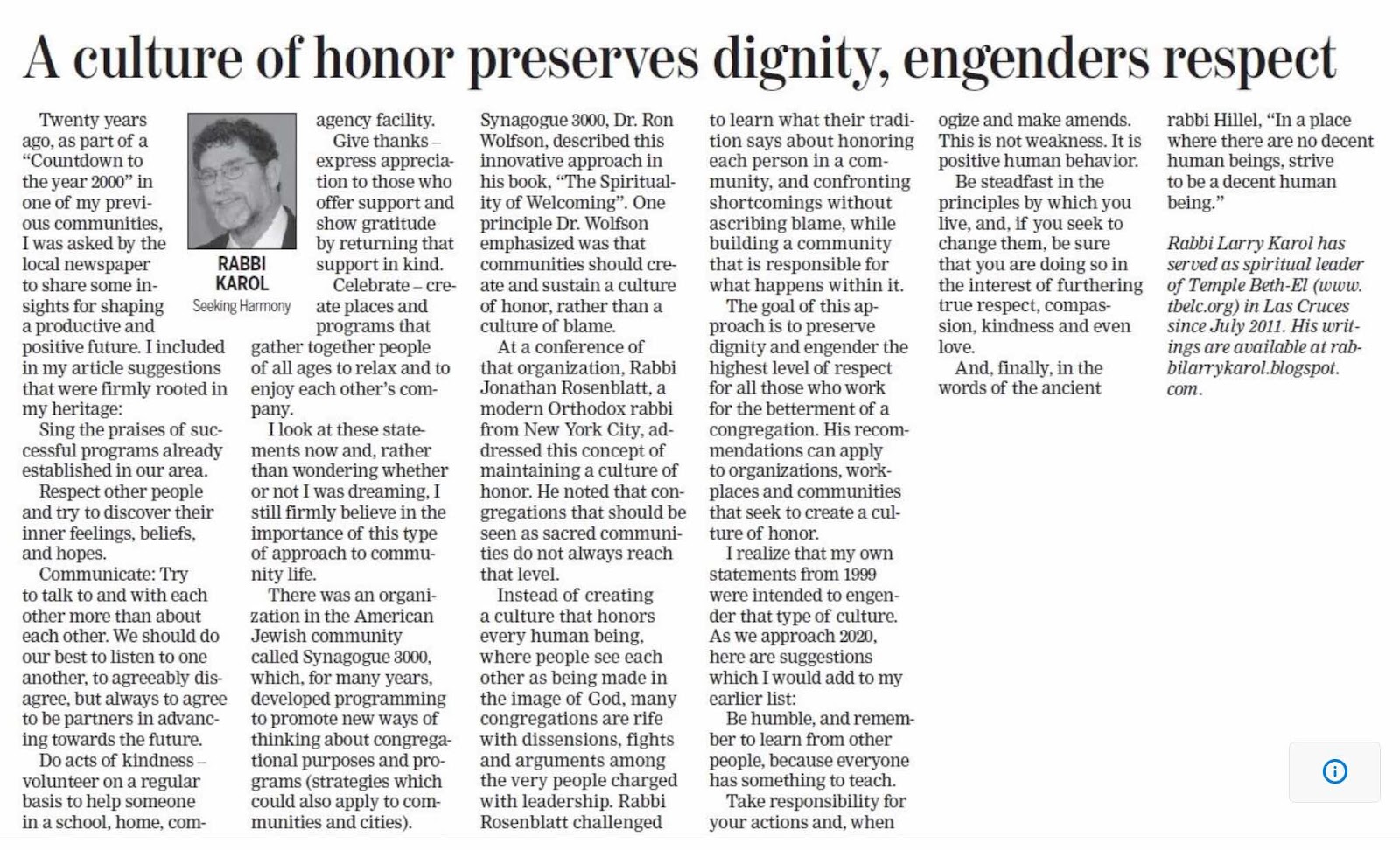
A culture of honor preserves dignity, engenders respect - Column for August 2, 2019 Las Cruces Bulletin

     Twenty years ago, as part of a “Countdown to the year 2000” in one of my previous 
communities, I was asked by the local newspaper to share some insights for shaping a 
productive and positive future. I included in my article suggestions that were firmly rooted in my heritage:
  • Sing the praises of successful programs already established in our area.
  • Respect other people and try to discover their inner feelings, beliefs, and hopes.
  • Communicate - Try to talk to and with each other more than about each other. We should do our best to listen to one another, to agreeably disagree, but always to agree to be partners in advancing towards the future. 
  • Do acts of kindness - volunteer on a regular basis to help someone in a school, home, community center or helping agency facility. 
  • Give thanks - express appreciation to those who offer support, and show gratitude by returning that support in kind.
  • Celebrate - create places and programs that gather together people of all ages to relax and to enjoy each other's company.
       I look at these statements now and, rather than wondering whether or not I was dreaming, I still firmly believe in the importance of this type of approach to community life. 
    There was an organization in the American Jewish community called Synagogue 3000 which, for many years, developed programming to promote new ways of thinking about congregational purposes and programs (strategies which could also apply to communities and cities). 
   One of the founders of Synagogue 3000, Dr. Ron Wolfson, described this innovative approach in his book, The Spirituality of Welcoming.  One principle which Dr. Wolfson emphasized was that communities should create and sustain a culture of honor, rather than a culture of blame.  
    At a conference of that organization, Rabbi Jonathan Rosenblatt, a modern Orthodox rabbi from New York City, addressed this concept of maintaining a culture of honor.  He noted that congregations that should be seen as sacred communities do not always reach that level.  Instead of creating a culture that honors every human being, where people see each other as being made in the image of God, many congregations are rife with dissensions, fights and arguments among the very people charged with leadership. Rabbi Rosenblatt challenged congregational leaders to learn what their tradition says about honoring each person in a community, and confronting shortcomings without ascribing blame, while building a community that is responsible for what happens within it. The goal of this approach is to preserve dignity and engender the highest level of respect for all those who work for the betterment of a congregation.  His recommendations can apply to organizations, workplaces and communities that seek to create a culture of honor.   
    I realize that my own statements from 1999 were intended to engender that type of culture.  As we approach 2020, here are suggestions which I would add to my earlier list:  
  • Be humble, and remember to learn from other people, because everyone has something to teach.  
  • Take responsibility for your actions and, when necessary, sincerely apologize and make amends.   This is not weakness.  It is positive human behavior. 
  • Be steadfast in the principles by which you live, and, if you seek to change them, be sure that you are doing so in the interest of furthering true respect, compassion, kindness and even love.  
  • And, finally, in the words of the ancient rabbi Hillel, “In a place where there are no decent human beings, strive to be a decent human being.” 


A life of service - My column for the Temple Beth-El Las Cruces Adelante Newsletter for Augustl 2019


    I sometimes find myself revisiting my reasons to pursue the rabbinate. 
      I didn’t start, in earnest, until my senior year in high school.   I enjoyed my involvement in Youth Group, leading a panel of my peers, the “We Speak for Judaism Panel,” that spoke to churches in our community about the Jewish religion and our customs, practices and traditions.  
     I also became more involved in adding my own sense of spirituality through music at youth events and during special worship services.  
     I couldn’t have done that without my attendance in the National Torah Corps 7-week summer session in 1970 at the Union of American Hebrew Congregations Kutz Camp in Warwick, New York. We studied with rabbis who made a major impact on their communities and on American Judaism.  I had the opportunity to learn chords for some of the worship melodies that we used in my home congregation, which enabled me to add a new dimension to my participation in service music, after singing for several years in the junior choir.   Now, I could be a leader.
     Those pursuits continued at the University of Illinois in Champaign-Urbana, where I ultimately chose sociology as my major, and religious studies as my minor. I engaged in the study of Hebrew and Judaism in a number of college courses that further stablished my foundation of Jewish knowledge.   As a senior in college, the Hillel rabbi and other leaders chose me to be the inaugural intern in a new leadership development program.  I read books on Jewish thought, led a weekly Shabbat dinner at a dormitory, and co-directed the Hillel choir.  After an interview at Hebrew Union College-Jewish Institute of Religion in Cincinnati, in January of 1976, I was informed of my acceptance at the end of March.
      After five years of rabbinic school, and 38 years serving congregations, I continue to ponder what drew me to the rabbinate.  It was always about my own comfort with Temple life and Jewish tradition.   The music was part of it, but so were the prayers, the teachings, and being part of a community.   And, even more, it was about service and partnership.    I valued learning from mentors when I was an assistant rabbi in my first congregation, but I also have had many partners in making Judaism come alive, lay leaders who were committed to sustaining and enhancing the well-being of a community.   We did what we could to overcome challenges that arose in order to create a sense of joy among our members and an enduring and positive presence in the community. 
     Our recent family visit to Kansas City and Topeka reminded me of all of those reasons for being a rabbi, as we had a chance to connect with former Temple presidents, confirmands, congregants, community members, and friends.   We also connected with family, who have supported not one, not two, but three Rabbis Karol.  
     As a rabbi, I enjoy my interactions with members of all ages, as well as my participation in the greater community. 
     Temple Beth-El’s place in Las Cruces, and mine as well, came to mind on July 23, 2019.
     On that day, I attended the installation of the new bishop of the Roman Catholic Diocese of Las Cruces, Peter Baldacchino.   I began attending the diocese-sponsored luncheon that mostly included priests from around the state and some of Bishop Baldacchino’s friends.  I was impressed with the humility exuded by the religious leaders who were present, and the obvious camaraderie that pervaded the gathering. 
     At the installation,  I joined Pastor Jared Carson, spiritual leader at Peace Lutheran Church, and the Rev. Dr. Margaret Short, chaplain at Memorial Medical Center, in representing the interfaith community to greet the newly-installed Bishop.  
      The service included many moments of celebration, which generated a special spirit among all those who were present.   I saw and greeted a number of people with whom I have worked over the last eight years.   The theme of service was reflected in the statements of the installation speakers and in the songs that were included in the ceremony.  
       What surprised me was the gratitude that was expressed to me by people I didn’t know, over and over.  They appreciated that I was there, representing the Jewish community.   I also think that they see something spiritual, valuable, significant and godly in furthering Catholic-Jewish ties in a world that seems to seek division rather than commonality, prejudice rather than acceptance.
      And it wasn’t only for me that I attended.  I took you all with me through my presence. That is the essence  of rabbinic service to a congregation.  It is about the “we” that we create and sustain whether we are together or apart.  
      As we begin to prepare in the coming weeks for a new Jewish year,  may we remember to connect, celebrate, study, sing, and believe that the community which we create can take us to joy, healing, and hope. 

More learning...more wisdom! Reflections on #newcaje10 - August 2, 2019

   I had the opportunity to tell a story from the very beginning of my rabbinate in the last few days. 
    In August, 1981, I was scheduled to attend the Conference on Alternatives in Jewish Education (CAJE)  at Oberlin College.  One of my rabbinic school classmates was expecting me to provide a ride.  A death in the congregation (Temple Israel), while my senior rabbi was away, delayed my attendance.  A Religious School faculty member gave my classmate a ride to Oberlin on the Sunday that the conference began.   I officiated at the funeral in Cincinnati on Tuesday.  I got up early the next morning to take in at least one day of CAJE. 
     What I remember from that one day was seeing many people I knew, finding several meaningful learning experiences even in a very short time, and enjoying a Debbie Friedman concert that night.  It was enough to make me want to return.  
     And so I did, sometimes with my wife Rhonda, and sometimes with our son Adam as well.  Rhonda and I attended in 1982 soon after our wedding.   As a rabbi, a religious school director and faculty member, a bar/bat mitzvah tutor, a religious school music teacher, and a Confirmation class teacher, there was so much to learn that I felt I needed an annual infusion of insights, knowledge, direction, inspiration, and clues on how to develop new skills to enhance the passing of Judaism from one generation to the next.  
      I attended the conference 18 times. I sang in the CAJE Chorale from its inception in 1989.  Once I became a Jewish singer/songwriter, I performed my original music on CAJE stages for five years.   
       A variety of considerations required CAJE to close in 2008.  The concept and spirit of CAJE, as well as the persistence of community ties that had developed over many years, combined to demand a renewal of the organization and conference in some form. A mini-conference in Baltimore in 2009 proved that notion, and then NewCAJE was born, holding its first conference at Gann Academy in Waltham, Massachusetts in 2010, which I attended during my rabbinic service in New Hampshire.     I again joined the NewCAJE community in person in 2015, 2016 and 2017 as a rabbi from New Mexico. 
       I have just returned from NewCAJE 10, held on July 28-31 at Reed College in Portland, Oregon.  I have only traveled to the Pacific Northwest (Washington and Oregon) because of CAJE/NewCAJE! 
      Admittedly, I could feel the “miles” on my personal odometer over these last few days.   However, my continuing thirst for new insights, skills and knowledge is the same as in the summer of 1981, when I was a mere 26 years old! 
     I attended sessions on teaching about antisemitism, Judaism’s views on welcoming the stranger and how they relate to immigration, the links between songwriting and lesson planning, songs about God, treasure troves of Jewish music to share with students, how to create productive dialogue about peace in the Middle East, and the transmission of tradition embodied in the rituals and prayers of the Passover Seder.  I once again added my “bari-tenor” voice to the NewCAJE Chorale, directed by Ellen Allard, and a number of us were treated to a delightful session with Eric Kimmel, author of Hershel and the Hanukkah Goblins.
     It was a m’chayeh to be part of a community that included a few people whom I have known for over 40 years, along with other familiar NewCAJE participants, plus discoveries of  “small world” connections (which included colleagues and family members) with attendees I had just met.         
     The late-night “kumsitz” (come and sit) is a CAJE and NewCAJE tradition, providing an opportunity for us to engage in a musical jam with colleagues.    This year, those of us who brought guitars (some of have done this together before...a lot) and ukeleles and everyone present sang classic Jewish/Israeli songs and popular hits from the 1960s, 1970s and 1980s.  It was an intergenerational community that joined in song until the early hours of the morning!  
     The concluding ceremony on Wednesday, July 31 was an expression of heartfelt gratitude from individuals who spoke for many of us.  To Cherie Keller-Fox, NewCAJE President, staff, and everyone who made NewCAJE10 possible, thank you, and to NewCAJE, on to 11 and many, many more!

Friday, July 19, 2019

Blessing all the people (A Modern Original Midrash) - D’var Torah - Parashat Balak - July 19, 2019

The prophet Balaam had been called by Balak, the King of Moab, to curse the Israelites, who were encamped in the desert. 

He ascended the mountains nearby with the Moabite monarch, a vantage point that provided him with a view of the entire people.   

But he knew that he was not in control of all of the words he would speak. 

God had told him that he would only be able to say what God allowed. 

Balaam told the King about this caveat, but Balak insisted that Balaam fulfill his mission. 

Before he began, Balaam stepped away, telling the King that he needed a private moment. 

“Balaam!”   God called. 

“Yes, Eternal One, I hear You.”  Balaam was fearful, even though he had already heard God’s instruction. 

“What are you doing?  Go ahead - go back and speak.” 

“I still want to curse them, God, but I know You won’t let me do that.  So, if I bless them, whom will I be blessing?”    

God, as much as God could be, was puzzled.  “What do you mean?” 

Balaam replied, “I have heard stories about the Israelites.   Moses is a humble, spiritual and powerful leader that this people has followed for many years.   Some of the people have doubted him.  Others rebelled against him.  You give them food and provide them with water in the desert.  They should be grateful.   Do they all really deserve blessing?” 

    God was a bit startled, but answered forthrightly. “The stories you have heard are true. They have worn Moses down too many times.   They have worn Me down, too.  Even when I wanted to give up on them, Moses wouldn’t let me.   So here we are, tied together in an eternal covenant, with rules engraved in tablets of stone and in the teachings of leaders to the people, and parents to children.   They were slaves, and now they are free, and at least most of them are grateful.” 

    Balaam was moved by God’s commitment to this people.   And then he asked, “God, do you love them?”   

     God was pleasantly surprised by the question.  “Why, Balaam, yes, of course I do.   Just because they have doubted me doesn’t mean I don’t love them, and I feel their love in return.” 

     Balaam posed one more query.  “God, do they love each other?  Are they a people that will teach about what it means to love one another?” 

     God replied, “Why, Balaam, does that matter to you?”  

    Balaam responded, “Because I was called here due to the hatred of a King that wants to see this people cursed to the point of extinction.   If all I can do is bless them, I want to bless a people that will dispel hatred and spread greater respect and love that will end the conflicts that plague us all too much in this world.”

     God reassured the foreign prophet, “You have nothing to worry about, Balaam.   I will guide them, inspire them, direct them, and teach them from one generation to the next.   They will learn from one of their teachers many centuries from now, ‘What is hateful to you, do not do to your neighbor.’  They will see their experience as slaves as a reason to treat the stranger with compassion.   Is that enough of a reason for you to bless them rather than utter curses that will destroy them?”

     Balaam quietly replied, “Yes, Eternal One.   If my blessings will begin a process of bringing conflict to an end in the distant future, I will bless them.   Can you guarantee that this people will be moved by my blessing in the generations to come, enough to spread love, respect and hope?” 

     God replied, “Even after all I have been through with the Israelites, I have faith in them as they believe in Me.”  

     “All right, I am ready.”  Balaam walked back to Balak the King, and began uttering his prophecy.  

“How fair are your tents, O Jacob, Your dwellings, O Israel - MAH TOVU OHALECHA YA-AKOV, MISH-K’NOTECHA YISRAEL.”  


Thursday, July 18, 2019

Invocation - Temple Beth-El Las Cruces Board Meeting on July 18, 2019 - Understanding and Peace on the Earth and the Moon

 Eternal One,

Creator and Sustainer of us all, 

Activate our wonder 

So that we can marvel in achievements and discoveries

That have revealed crucial information about 

The origins of our solar system

 The connections between the earth and the moon, 

And our place in this wide and amazing universe. 

Enliven our curiosity so that we will seek more knowledge

About the unity within creation 

Not only in the heavens 

But here in our world.  

As we have conquered the fear of the unknown by 

reaching for the skies, 

May we overcome the temptation to approach people from different origins and backgrounds only with fear. 

May our arms, eyes and ears be open 

To the stories of our fellow human beings 

So that we can recognize the resonance of their narrative

With our own story 

That traces how we came to live in this country and community.  

May we be steadfast in our own positions and beliefs,

And may we also defend the rights of those who hold opposing viewpoints to our own

With the hope that, somehow, some way, we might be able 

To find a path towards compromises that can begin to solve the challenges we face.  

Remind us that loving our neighbors and the stranger as ourselves

Requires a rejection of bigotry and prejudice in whatever form they may take.

Bind us together as one human family in ways that will 

Lead us to true understanding and lasting peace.  

Amen.

Friday, July 12, 2019

Everyone’s life is worthy of a trading card - Column for Las Cruces Bulletin - July 5, 2019

      I was recently reviewing sports trading cards (baseball, football, basketball) that our son had collected, mostly in the 1990s. My goal is to pare down what we have to a reasonable amount. Whileit is easy to keep the cards of “name” players in each sport, there were other cards that required closer examination.
    Those were the cards of players who may not have been the stars of their teams, but who were significant enough to deserve trading cards featuring the appropriate action shot and their statistics.
   I searched for information for every single player whose name escaped me. Of course, simply making it to the Big Leagues is a source of pride for a player, parents, relatives and friends.
    I served a congregation in LaSalle, Illinois, for three years as a student rabbi for 18 weekends a year, flying from Cincinnati to Chicago and then driving to my destination. On one of my flights back to Cincinnati, I sat next to the wife of Cincinnati Reds pitcher Frank Pastore. I remember the couple with her telling her before we boarded the plane, “We will be sure to watch his games when we can.” Frank Pastore eventually became a well-known Christian radio talk-show host in Los Angeles. He died from injuries sustained in a motorcycle accident in 2012.
    In one of my early years as rabbi at the congregation in Topeka, Kansas, I received a call from a woman named Beth who said that her husband was looking at a job possibility in the area. She was Jewish and wanted to attend services on the Jewish High Holy Days. She eventually told me that her husband was a former baseball player named Joe Keough.
     I said, “You mean Joe Keough who played on the Kansas City Royals, who got the gamewinning hit in their first regular season game in April 1969 against the Minnesota Twins?” I think I left her speechless.
    It was just that type of accomplishment that led me to keep certain trading cards. Players who did something significant in one game or in one season, or who became coaches, analysts and broadcasters got my nod for retention.
    As we celebrate Independence Day, we can think of all those people in the history of the United States who have made contributions to the preservation of freedom, constructive and productive discourse, and acceptance of one another as fellow travelers along this journey, which is approaching 250 years in the not-too-distant future.
   We are also closing in on the 50th anniversary of the first moon landing on July 20, 1969, during the Apollo 11 mission. Books, articles, documentaries, and feature films continue to chronicle this accomplishment. We are finding out more and more about the diverse group of people who comprised the team that made Apollo 11 happen. Every person involved in the mission, from the construction of the vehicles to the splashdown recovery team, had a significant role in the success of that historic flight and the space program.
    An 1800-year-old rabbinic saying highlights the importance of each person to our world and our lives: “Despise no one, and call nothing useless, for there is no one that doesn’t have his/her time and there is no thing that doesn’t have its place.”
    Every one of us has an opportunity to further human achievement, freedom, respect and decency. May that be our continuing mission.

Patience, Humility and Hope - D’var Torah - Parashat Chukat - July 12, 2019

     I have closely followed the American space program beginning with the missions of Gemini 7 and Gemini 6 in December 1965.   I remember the graphics in Time magazine illustrating their combined flight that achieved the milestone of the first rendezvous in earth orbit between two manned spacecraft.   The photographs shared after the flight of the two Gemini capsules flying close to one another was impressive.   Successful exploration of space was the result of ingenuity, insight, teamwork, and patience.  The Mercury and Gemini programs represented the first steps to accomplish President John F. Kennedy’s goal to land astronauts on the moon by the end of the 1960s.   

     Public Television aired, earlier this week, their series entitled “Chasing the Moon” to mark the 50th anniversary of the Apollo 11 moon landing.    Each program chronicled the gradual progress of the manned space program, with flights that provided the building blocks and skill and hardware development necessary to assure, as much as possible, a safe moon landing.  

     The second episode of the series included what I would consider to be the most detailed portrayal of the ill-fated Apollo 1 mission.   Astronauts Gus Grissom, Ed White and Roger Chaffee died when a fire broke out in their Apollo capsule cockpit during a test of communications and other systems on January 27, 1967.   I was watching television that night when the network interrupted regular programming with the announcement of the fire and tragic loss of life.   The details of what happened and photos of their charred capsule were shared in the days and weeks that followed.  The commentary during the “Chasing the Moon” episode discussed the attitudes that may have led to the tragedy.    Impatience and arrogance by those who created and produced the Apollo capsule led them to assume that everything would be fine, because everything had always been fine before.   No one questioned the risk of maintaining a 100% oxygen atmosphere, in a crew cabin filled with flammable materials,  during the test that ultimately took the astronauts’ lives.  No one seemed to consider the possibility that a hatch that opened into the capsule, instead of one that opened out, would prevent workers outside the spacecraft from being able to offer crucial help in case of an emergency.   Later that year, I visited the graves of two of the Apollo 1 astronauts at Arlington National Cemetery.  While the astronauts knew of the dangers of space flight, the consequences of that night lingered for many months, as NASA worked with the companies involved to ensure the safety of the revamped Apollo capsule.      

     As I listened to the newly-told story of Apollo 1, I thought of Moses and Aaron in this week’s Torah portion.   God told Moses to speak to a rock to produce water for the people, who were, once again, complaining that they had been brought into the wilderness to die.   Once before, God had told Moses to strike a rock to produce water.  The intensity of the tumult among the people wore Moses’ patience thin.   He had always given God credit and gratitude for all of the divine acts that had preserved the Israelites on their journey.    This time, the usually humble leader seemed to change his tune. He proclaimed over the shouting of the Israelites, “You rebels, shall we get water from this rock?”   Then he struck the rock, yielding the desired stream of water for the people to drink. 

      God immediately told Moses and Aaron that they would not lead the people into the land of Canaan.   We might think that Moses and his brother deserved at least a little mercy in the face of this impatient people.  What they learned is that every word and action counts, and that letting down one’s guard, even once, can have dire consequences for the moment and for the future.  Moses’ lack of patience led him to portray himself to the people as having divine power.   He violated one of the central principles of his service to God and to the Israelites - that he was their human guide, following God’s direction along the way.   He probably realized that it was time to appoint Joshua as his successor and to train him to be humble, patient, steadfast and always optimistic.  

   The lessons learned from the Apollo 1 fire ultimately led to the success of the Apollo missions to the moon, which featured 6 moon landings along with the crew in space and on the ground overcoming seemingly insurmountable odds during the flight of Apollo 13.   

     In our own lives, there may be challenges that arise which require us to be patient, humble, and hopeful, and which might call on us to recognize the potential partners nearby who can share our concerns and lighten our burdens.   May we accept,  with open arms, the support and help that comes to us, so that we will proudly and safely reach our destination, whatever it may be.