Thursday, September 21, 2017

"Who are we and how did we get here?" - Rosh Hashanah Evening Sermon 5778 - September 20, 2017 (Temple Beth-El, Las Cruces, NM)

Shanah Tovah to all of you who have joined us tonight.
This night provides us with a special opportunity.  It is available only to people who celebrate Rosh Hashanah as the New Year. 
    For most of the world, tonight and tomorrow are primarily identified as days in the year 2017.   This calendar year has challenged our sense of truth, justice, hope, security, trust and peace.   It has pitted people against each other who could, if they only tried, find something in common.   2017 has subjected us to moral whiplash, verbal exhaustion, mental confusion, and communal despair.   And some of you will understand if I say the words “duck and cover,” because who hasn’t thought about that, even for an instant, in light of the actions of North Korea?
     Here at Temple Beth-El, and in the Jewish world, we do mark the year, on one level, as 2017.  We haven’t been totally sheltered from all that is happening around us.
    But we do, still, have a special opportunity tonight.
    We get to turn the page.
     Not a page in a book. 
     We have turned our Jewish chronological page to a new year.   It’s now 5778.
     Everything that happened in the Jewish year 5777 will still be with us when the High Holy Days are over.
     However, because we have turned our page, we have the chance to help ourselves and the world make a change towards renewal, building on the moments when our best gifts emerged in 5777 so that 5778 will be different. 
   In our service tonight,  we are about to read the prayer for holiness.      
   During this last year, the notion of holiness seems to have been far from many people’s minds.
    Or, the word “holy” may have been employed in the sense that some people see themselves as holier than others, believing that their faith makes them better, more righteous, more saved, more deserving of God’s blessing.
    Judaism teaches that, if we seek to be trustworthy, respectful, peaceful, honest, and hopeful, then righteousness and holiness will naturally follow for any person.  
     Rosh Hashanah provides us with a time to refocus, to remember that our heritage demands that we hold ourselves to a high standard of behavior that is reflected in the prayers of the Machzor, the High Holy Day Prayerbook.  There are specific values at the foundation of Judaism which we still teach and discuss and by which we are called to live so that we can serve as exemplars for everyone around us. 
    During these High Holy Days, as we use Mishkan Hanefesh for the first time during several of our services, I want to take the opportunity to consider the meaning and implications of one particular reading in each service.  Tonight, it is the reading on page 48.   My title for my remarks tonight was “Who are we and how did we get here?”   This reading and the prayers that follow actually answer my question.
     Our prayers and our tradition teach us that we are here because God put us here.  There are many ways to express that belief, but when we speak of such things in Judaism, even our prose, which seems literal, is poetry.  Acknowledging God as our Creator requires of us a great measure of humility.  We have developed our own power, but it’s not ultimate by any means.   Our natural setting, our beautiful sunrises and sunsets that often present a colorful collage in the sky, and the great eclipse - all of these elicit in us a sense of wonder and amazement.   The word YIR’AH in the holiness prayer can mean fear, but it can also mean awe and reverence.   The first part of the holiness prayer says, “We yearn for connection with all that lives, doing Your will with wholeness of heart.  Awe-inspiring is Your creation, all-encompassing is Your transcendent name.”  
    Every faith group has its own belief about how to mirror God’s will in an approach to people and to the natural world.   There are some of our fellow Americans who believe that only they know God’s true will, which gives them special privileges.  A movement called Dominionism accepts only people who profess a certain type of Christianity as being worthy of positions of leadership in our nation because of their supposed moral and spiritual superiority.   The yearning for such power and control would lead to a fulfillment of only one narrow view of a divinely ordained mission as applied to citizens and to the lands that are our national treasure.   It also rejects interfaith partnerships that could bring people closer together.
    There are other people who take a much different approach.  In Las Cruces, for me, that is realized in small group settings, one with clergy, and another every Friday noon with a group of lay people and ministers who come from the Christian, Jewish, Muslim and Baha’i traditions.  Our book discussions enable us to share our beliefs in a cooperative and enlightened spirit.
    Dr. Andrea Weiss of Hebrew Union College-Jewish Institute of Religion in New York City activated a network of her fellow scholars of religion to create the “American Values, Religious Voices” campaign that developed letters to send to our national leaders for the first 100 days of the new administration.   The breadth and depth of the resulting expressions about the principles that emerge from our faith groups was breathtaking.  I believe that God wants us to be equal partners in sustaining not only creation, but also in developing stronger ties with each other across our differences.  The divine essence in each of us and all of us is holy, and when we discover that spark in ourselves and in others, holiness happens all around us.   Such sacred partnerships in the greater community and the world should be our goal.
    The second part of the Holiness prayer on page 50 speaks of Jews all over the world.  The note at the bottom of the page explains, “This prayer…reflects for the Jewish people - often marginalized, misunderstood, and despised – a yearning for honor and recognition, a secure place among the nations.” 
    We probably think of ourselves as secure now. Or, with recent events, perhaps not.   
     Last January, I was first invited to the Friday discussion group which I attend to teach about Jews and Judaism in America.  We used as our text my teacher Dr. Jonathan Sarna’s book, AMERICAN JUDAISM.   In that chronicle of history was this paragraph that described the status of Jews in relation to the rest of the population nearly a century ago: 
    “Immigration restrictions that sought to restore the nation's ethnic mix to its nineteenth-century white Protestant character also aimed directly (though by no means exclusively) at Jews. The House Committee on Immigration received a report prepared by Wilbur J. Carr, the director of the Consular Service, and approved by the secretary of state, that described Jews who desired to migrate to the United States as being, among other things, ‘undesirable,’ ‘of low physical and mental standards,’ ‘filthy,’ ‘un-American,’ and  ‘often dangerous in their habits.’ Resulting legislation - the 1924 Immigration Act- [targeted but] never mentioned Jews, and it restricted… immigrants like Italians and Slavs no less stringently, while Asians were barred entirely. ‘Chauvinistic nationalism is rampant,’ Louis Marshall, the foremost American Jewish leader of his day, recognized. ‘The hatred of everything foreign has become an obsession.’”
     Libby Garland, in her book AFTER THEY CLOSED THE GATES, detailed how the restrictions of the 1924 Immigration act put in jeopardy many Jews in Europe, who had already acquired legal visas to come to the United States.   They had left their homes believing they could safely embark on their journey, only to discover that the new immigration act would delay their entry because quotas for the nations from whence they came had been filled.   Many of those Jews wishing to join family members who were already here were forced to resort to a wide range of means to enter in a timely way.  If they saw the anti-Semitic handwriting on the walls of their European towns and cities, we shouldn’t be surprised if these despairing Jews listened to anyone who promised to get them to America.  Sometimes they found out too late that the pathway they were taking was illegal.   Libby Garland was only able to chronicle the stories of those whose efforts were thwarted by American officials.  She estimated that tens of thousands of Jews immigrated “under the radar” to the United States from Europe, quietly circumventing a system that was dedicated to keeping their numbers to a mere, insignificant trickle.
   That was a long time ago, but echoes remain of prevailing attitudes of that time.  The “unite the right” rally in Charlottesville in August reminded us of that.   In the flurry of discussions, reporting, and activity surrounding the events of those tragic days last month, the chants of “Jews will not replace us” and the originally Nazi slogan, “blood and soil,” and descriptions of armed right-wing demonstrators standing across from the Temple in Charlottesville, were almost drowned out.   But not for us. We heard.  We mourn the death of Heather Heyer, whose passion for values that resonate with the heart of Judaism led her to attend the counter protest.  We are fortunate to be in a position to make our voices heard when such hatred is expressed from wherever it may come, including specific campaigns against the State of Israel that employ classic anti-Semitic language and imagery.   Sometimes we don’t know where to turn, other than to the core of our heritage:  the teachings of the Torah, the wisdom of the rabbis, the give-and-take discourse that characterizes Jewish tradition, where we should be able to sit with one another and talk as equals with humility and utmost mutual respect.    That goes for us, and it should go for Jews all over the world, including  those who gather in the precincts of the Western Wall, the Kotel.  At that historic site, women who seek to pray aloud in reverence and joy, and the Orthodox women and men who protest their monthly public worship with whistles and catcalls, should, because they are all Jews, be able to find a way to admit that, even with their differences, they are part of the same community.   In the words of the holiness prayer in MISHKAN HANEFESH, “May the sparks of David, Your servant, soon grow bright enough for us to see a beam of light in the darkness, a promise of perfection.”  Hopefully, there are ways in which that light still can shine down on us, so that fellow members of the Jewish community who live near and far will be able to fashion and maintain sacred partnerships that will take us into a bright future.
    The final section of the holiness prayer, according to the note on page 51, “envisions a future in which good people will see the reward of having held fast to their ideals: a world in which righteousness prevails.” 
     A brief story.  On Wednesday, August 2,  I had a number of different places I could have been.  My choice for that day was to work on some congregational projects and to take our major High Holy Day mailing to the post office.
    As I left the building, three high school students came by Temple.  I asked them if they needed help or if they were just passing by.  They said they were fine, so I continued walking to my car, but I looked back and saw them eyeing our outside display case.  I approached them again, and they told me they wanted to know more about Temple, Judaism and what was inside.  So, I opened the door and let them in. Don’t worry, they were NOT a security risk.  I could tell that they were having an inquisitive moment.    For me, it became a teachable moment.   I showed them the Sanctuary and explained the various symbols around this sacred space.  I opened the ark and took the cover off the middle Torah.   As I set it for the portion for the coming Shabbat, I explained to them:  “You are here in a good week to see what’s in the Torah.  Here are the Ten Commandments and here is the statement of one God, the Shema. Both are central to Judaism.   Had you come at another time, I wouldn’t have been able to show you these important passages in the Torah so readily!”  Perhaps God works in mysterious enough ways that I was reminded, as I spoke to these students, that we do have something very special and crucial to offer the world.   It’s why much of what I have written in the last year in local publications has been about values that many people share.  Principles for life require us to dedicate ourselves to human decency - to menschlichkeit, so aptly highlighted by Global Character Day creator Tiffany Schlain (www.letitripple.org) in the material that was the centerpiece of our Selichot Discussion last Saturday night.  It wasn’t only that Torah reading of the first week of August that contained central tenets of Judaism.  In the following week’s parashah was this passage from Deuteronomy Chapter 10:   
 And now, O Israel, what does the Eternal your God demand of you? Only this: to revere the Eternal your God, to walk only in divine paths, to love and to serve the Eternal your God with all your heart and soul, keeping the Eternal's commandments and laws, which I enjoin upon you today, for your good.  Mark, the heavens to their uttermost reaches belong to the Eternal your God, the earth and all that is on it!  Yet it was to your ancestors that the Eternal was drawn out of love for them. Cut away, therefore, the thickening about your hearts and stiffen your necks no more.  For the Eternal your God is God supreme and Lord supreme, the great, the mighty, and the awesome God, who shows no favor and takes no bribe, but upholds the cause of the fatherless and the widow, and befriends the stranger, providing food and clothing. You too must befriend the stranger, for you were strangers in the land of Egypt.”
     This was the vision in Deuteronomy of how we can bring righteousness in the world.   That was then.  In 5778, who are we?  We are still people called upon to open our hearts, to take the teachings of our heritage and apply them in our relationships with each other and with all of the human family, with a sense of God’s presence guiding us along the way.   Practicing these values could begin to assure, in the words of our prayer, that we will live in a world where “evil has no voice,” where “the stunning sight of arrogance” will be “gone from the earth,” and where the God of holiness will be made holy through OUR righteousness.
       One last question is, how did we get here? That is still a mystery on some levels, and it raises another question:  What or where is “here,” which can also include the notion of “now”?   For the moment, “here” is tonight, as we find ourselves at the beginning of a new Jewish year.   “Here” is a world that is so intricately connected that we can converse with people halfway across the planet in an instant.   “Here” is a national and global situation when disagreement and conflict could tear humanity apart. 
      But “here” can also refer to this moment, this new year, that gives us an opportunity to turn the page, to carry over the best of our past, as we seek to explore among ourselves what Judaism can give the world:  a sense of blessing, hope, justice, righteousness, and peace.   May we walk together in sacred partnership as we move forward into the future, joining with others to discover the spark of God and godliness in one another that will lead us all to a MAKOM KADOSH, a holy place, wherever we may be. 


Sunday, September 10, 2017

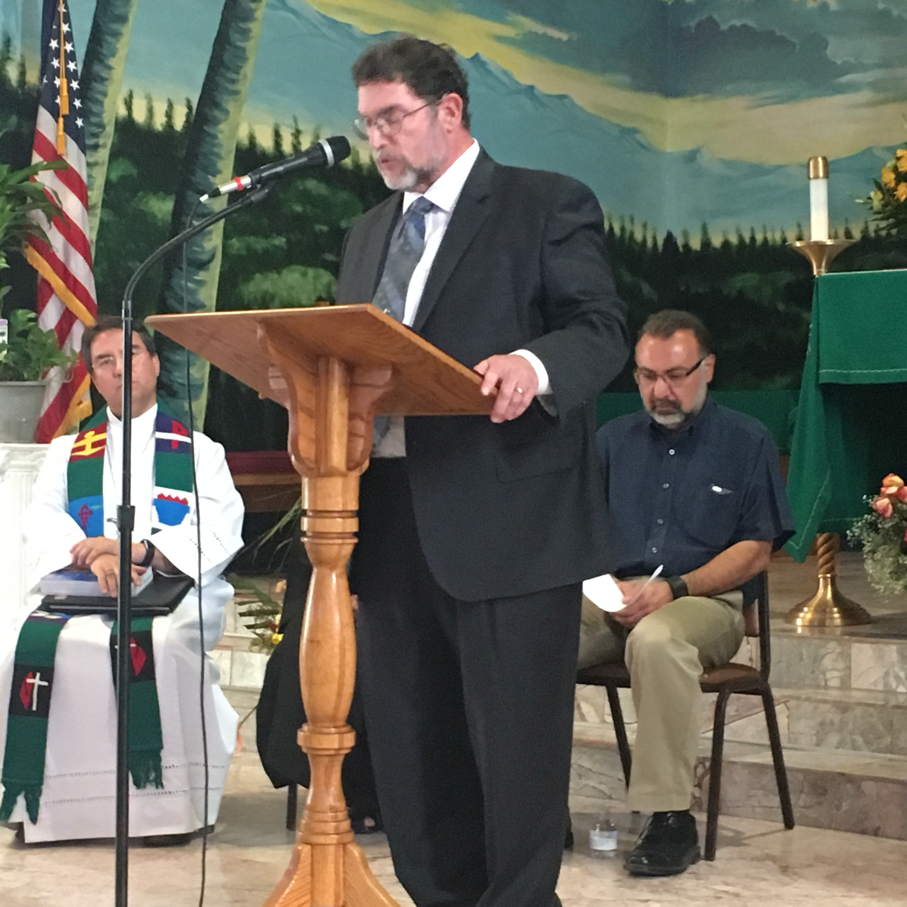
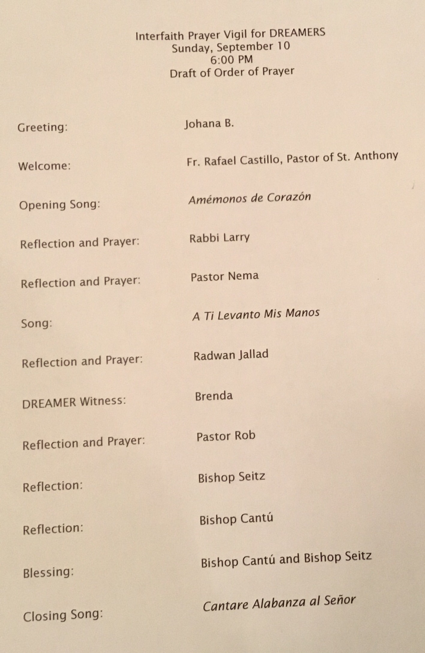
Statement at Prayer Vigil to support DACA recipients - St. Anthony Church, Anthony, NM - September 10, 2017

   I appreciate the invitation to be here tonight to stand in solidarity with people of faith to support recipients of the DACA program and to affirm their place in the greater American community.   

    I speak not only as a rabbi of a congregation in this border region.   I stand here as a grandchild of immigrants.  My grandparents left the Jewish communities of Lithuania and Poland to create a new life in the American midwest.    They had all arrived by 1905 in this country.  Had they waited, they would have fallen victim to the 1924 Immigration Act which set limits on the number of immigrants from specific countries, including their own communities in Eastern Europe.     

    Dr. Jonathan Sarna, with whom I studied during my years of rabbinic school, wrote a book on the history of American Jews and Judaism.  He explained that the goal of the 1924 immigration restrictions was to “restore the nation's ethnic mix to its nineteenth-century white Protestant character.”  One American official reportedly told Congress around 1923 that Jews who desired to migrate to the United States were "undesirable," "of low physical and mental standards," "filthy," "un-American," and  "often dangerous in their habits." The 1924 Act never specifically mentioned Jews or any other groups it sought to keep out.  The motivation was still very clear.  One Jewish leader of that time, Louis Marshall, lamented,  "Chauvinistic nationalism is rampant.  The hatred of everything foreign has become an obsession."

    History sometimes seems to have a way of repeating itself that we don’t need or want.  As I said at a public event earlier this year, we have seen this movie before, we didn't like it then, and we don't like it now. 

    However, treasured ancient texts, for me, the Torah, continue to send down to us today a message of decency, respect and compassion.   This passage from Deuteronomy Chapter 10 has much to teach us now, in this moment, when we need to hear God’s voice. 


יב וְעַתָּה֙ יִשְׂרָאֵ֔ל מָ֚ה יְהוָֹ֣ה אֱלֹהֶ֔יךָ שֹׁאֵ֖ל מֵֽעִמָּ֑ךְ כִּ֣י אִם־לְ֠יִרְאָ֠ה אֶת־יְהֹוָ֨ה אֱלֹהֶ֜יךָ לָלֶ֤כֶת בְּכָל־דְּרָכָיו֙ וּלְאַֽהֲבָ֣ה אֹת֔וֹ וְלַֽעֲבֹד֙ אֶת־יְהוָֹ֣ה אֱלֹהֶ֔יךָ בְּכָל־לְבָֽבְךָ֖ וּבְכָל־נַפְשֶֽׁךָ:

And now, O Israel, what does the Eternal your God demand of you? Only this: to revere the Eternal your God, to walk only in divine paths, to love and to serve the Eternal your God with all your heart and soul, keeping the Eternal's commandments and laws, which I enjoin upon you today, for your good.  Mark, the heavens to their uttermost reaches belong to the Eternal your God, the earth and all that is on it!  Yet it was to your ancestors that the Eternal was drawn out of love for them. Cut away, therefore, the thickening about your hearts and stiffen your necks no more.  For the Eternal your God is God supreme and Lord supreme, the great, the mighty, and the awesome God, who shows no favor and takes no bribe, but upholds the cause of the fatherless and the widow, and befriends the stranger, providing food and clothing. You too must befriend the stranger, for you were strangers in the land of Egypt.”

יח עֹשֶׂ֛ה מִשְׁפַּ֥ט יָת֖וֹם וְאַלְמָנָ֑ה וְאֹהֵ֣ב גֵּ֔ר לָ֥תֶת ל֖וֹ לֶ֥חֶם וְשִׂמְלָֽה: יט וַֽאֲהַבְתֶּ֖ם אֶת־הַגֵּ֑ר כִּֽי־גֵרִ֥ים הֱיִיתֶ֖ם בְּאֶ֥רֶץ מִצְרָֽיִם


This passage isn’t the one that has been most often quoted as we have faced a national leadership that has a desire to define what it means to be American with a skewed sense of history and a narrow-minded perspective.   I gravitated to these verses because they direct us to walk along godly paths, to do good, and to acknowledge the vastness of creation which can only remind us to be humble.  

    The call to “cut away the thickness around our hearts” and to refrain from taking a stiff-necked approach to community means to be open to new ideas, to act with compassion, to empathize with everyone created in the divine image, and to understand that the cries for help from our fellow human beings can and should take precedence over an inflexible application of the rule of law to every situation.   Just ask the people who had legal visas to enter the United States in 1924 and were then trapped in Europe because they were told that the country-by-country quotas had already been filled.   They felt abandoned and left with no hope for survival. And some of them ultimately did not survive.  

    The verses from Deuteronomy proclaim that God befriends the stranger, and, because of that, we must befriend the stranger as well.  This passage makes it clear that this is one way to be like God. 

   So that is why I am standing here today - to try to be like God, to ask all people to find it in the goodness of their hearts to support recipients of DACA and other aspiring citizens who have earned a right to take their own formal place in these United States.  

    And so, I pray…

    Eternal God, Creator and Sustainer of us all, 

You are the Author of Liberty and the ultimate source of hope. 

You place in every one of us a spark of your divine personality.   

You are a friend to the homeless, a provider for all in despair, a fellow traveler of the refugee seeking a better life, a guide for leaders who must make difficult decisions.  

And you are a steadfast companion to Dreamers who await human action to assure their well-being.  

Inspire our leaders to recognize the value of  diversity that can enrich our communities. 

Grant the blessings of safety and a secure future to the Dreamers whose only desire is to continue the lives they began as enthusiastic contributors to our vibrant American life. 

Enable us to rediscover within ourselves a generous spirit, open hearts, and boundless love that can encircle us as citizens of this nation who could also bring that love and peace to the human family. 

   Be our friend, Eternal One, and help us to be good friends to each other, so that no one will be left outside the circle of human decency in which they rightfully belong. 

    And we say Amen. 


Sunday, September 3, 2017

Different Religions and Common Values - New Year's Message for El Paso Jewish Voice - September 2017


  Late in 2016, Dr. Andrea Weiss of Hebrew Union College-Jewish Institute of Religion in New York City embarked on a project that sought to highlight values from different religions as central to American life. 

  Over 100 scholars and teachers of diverse faith groups joined her in the American Values/Religious Voices campaign (www.valuesandvoices.com).  For each of the first 100 days of the new presidential administration, a letter from one of the contributors was sent to the President, Vice-President, and other national officials.  

   When I spoke with Dr. Weiss in late January, she said that one of her greatest hopes was to listen to and learn from her colleagues.  The authors of these letters revealed how their religions prize values that are widely taught and emphasized in our society.     

   I led a community discussion in Las Cruces in early February on the letters. As we read the letters, we listed their central principles, which, at that session, included justice, mercy, humility, self-control, support of the vulnerable, compromise, diversity, a focus on the common good, creating common ground, seeing the whole as greater than its parts, responsibility, religious freedom, respect for all people, forgiveness, charity and building bridges.

    The “building bridges” reference came Jean-Pierre Ruiz, Associate Professor of Theology and Religious Studies at St. John’s University in New York City.  He noted that a sermon at a 2017 presidential inauguration service had quoted a passage from the book of Nehemiah about rebuilding the walls of Jerusalem.  Nehemiah 2:18 notes that the people “committed themselves to the common good” and together rebuilt their city.

   Professor Ruiz explained that, for the people of Jerusalem, building a wall was not about division.  It was about creating a physical and communal infrastructure.  It was about building bridges towards one another, and about putting a gate in the city wall though which visitors would be welcome to enter. 

    The values that we share offer us a moral infrastructure that can enable us to act in concert with each other for the common good.  We learn through our High Holy Day prayers that goodness begins inside each of us. 

    A reading in Mishkan Hanefesh: Machzor for Days of Awe (Central Conference of American Rabbis) clarifies how we can significantly enhance the “common good”:  “Throughout the year, regard yourself as equally balanced between merit and sin.  With one act, you can tip the balance for yourself, and for the world.  Every good deed makes a difference. And so it is written, ‘A righteous person is the foundation of the world’ – for one who does good tips the balance of the scales and can save the world.”

   May we each tip the balance towards good, for ourselves and for all of humanity, in 5778.

Values transcend divisive ideologies - Column for the Las Cruces Bulletin - September 1, 2017

      For most of my life, I have been fascinated with space exploration.  I still have a collection of articles from two major periodicals - yes, from the 1960s and 1970s - about the Gemini and Apollo programs.  As I write this article, I am watching “The Farthest: Voyager in Space,”  the documentary commemorating the 40th anniversary of the launches of Voyager 1 and Voyager 2.   The documentary “Mission Control: The Unsung Heroes of Apollo” chronicled the incredible support work of the team on the ground during the Apollo flights in earth orbit and to the moon and back.   

     The discoveries that resulted from these space missions are still amazing and wondrous.   What also captured my admiration and respect was the teamwork that enable these missions to be successful.   If I were to make a list of values/character traits that the scientists and engineers exhibited in their great work, it would need to include ingenuity, tenacity, curiosity, patience, perseverance, cooperation, creativity, partnership, responsibility, dependability, and trust.  

      Values have been on my mind a lot this year, as well as the importance of individual character building that can lead to strengthening the foundation of a community.  

      I recently attended the NewCAJE Jewish educators convention outside Oakland, California.  On the last night of the conference, we were treated to a talk by filmmaker Tiffany Schlain.    She spoke to us about her efforts to create movements towards improving who we are as individuals and as a worldwide community. Schlain founded the Webby Awards, which are presented annually to the best websites.          

        Schlain believes that we are in a world of interdependence, a reality that calls on us to be more considerate of   each other, more hopeful and thankful, more creative and loving, and more 

respectful and responsible.  To help make that possible, Schlain created Global Character Day, which has been marked by programs worldwide over the last several years.  Based on a long history of how we can improve ourselves, she created a “periodic table of character strengths” that categorizes a variety of traits into the categories of wisdom, courage, humanity, justice, temperance and transcendence.  For example, in this character-based periodic table, associated with wisdom are creativity, curiosity, love of learning, perspective and multi-disciplinary thinking.   Justice is tied to social responsibility, teamwork, fairness, leadership, taking initiative.  Courage is defined by bravery, perseverance, honesty and enthusiasm.  

     Schlain also added a “spiritual overlay” based on a movement of moral development in Judaism called “Mussar.”  That version of Global Character Day focuses on “how to be a mensch,” where, in Jewish tradition, a “mensch” is a decent human being.   

     I have always been a believer in character education. Values transcend many of the ideologies that divide us, enabling us to see that we may have much in common  with people who don’t agree with us otherwise. Tiffany Schlain’s periodic table may be nothing new, but if offers us a timely reminder that we human beings still have it in us to be people of good character. It is a project on which we should embark inside ourselves and in concert with one another every single day.   It is values such as these that have enabled us to make great discoveries, and could continue to lead us on that path in the years to come

     (For more information, go to www.letitripple.org).  


Friday, September 1, 2017

God in our help and hope - Article for Temple Beth-El Las Cruces Adelante Newsletter for September 2017

       “Sing to the Eternal One with thanksgiving;  make music to our God on the lyre. It is God who covers the skies with clouds, who prepares rain for the earth, who makes the mountains green with grass, who gives animals their food, and who even feeds the raven’s young when they call out for nourishment.  The Eternal One neither esteems the might of horses nor delights [primarily] in the strong legs of human beings.  The Eternal One delights in those who show reverence, who put their hope in God’s unfailing love and mercy.” (Psalm 147, Verses 1, 8-11). 
   There are a number of passages in the Tanakh that express this belief in God as the Creator of the world who is the source of rain and food…and hope and love.
    On August 21, many people flocked to the locales in the United States where they could witness the full extent of the total solar eclipse.  Clouds and rain on that day obscured the view of a major celestial event in some places.   In other locations, like in Charleston, South Carolina harbor,  a thunderstorm skirted the viewing area during the long-anticipated moment of totality.   Those who did not venture hundreds of miles for a “front-row seat” for the eclipse found some sense of involvement in the day with their pinhole projections, the use of telescopes or binoculars to view the unusual crescent sun, or taking the kitchen colander to create multiple images of the partially obscured light source in the sky.   The eclipse provided us all with a day when our divisions were briefly eclipsed as we all become curious human beings, overcome by our amazement. Even if we just uttered the word, “Wow!,” that was a prayer in and of itself.
     In the lead-up to the eclipse, there were online discussions about which blessing to say for an eclipse.   Some said it is the one that is recited for hearing thunder, which praises God “whose power and might fill the world.”   Others asserted that it was the general blessing for creation’s wonders, which gives blessing for God as the “One who made the works of creation.”  One prayer seems to respond to short term occurrences in nature, while the other acknowledges long-term miracles.
     We know from living in Las Cruces that rain can be a blessing when it ends a span of days with no drops from the sky.  We also experience too much rainfall at one time as an obstacle to our intra-city travel, and as a potential cause of unwanted damage to homes and property. 
     I was once in the presence of a major civil rights activist from Alabama, a pastor who was speaking at a Martin Luther King, Jr. event soon after the 2004 tsunami.   In his remarks, he proclaimed his conviction that God had sent the tsunami for a reason.  My clergy colleague sitting next to me turned to me and said, “Did he just say what I think he said?”  I could only respond, “Yes….he did.  And I am surprised.” 
      Too much rain, as we can see from the damage and challenges in the wake of Hurricane Harvey, is a result of the forces of nature at work.  Many scientists would surmise that the excessive rain is directly related, at least in part, to human interaction with the natural world.  
    So where might God be in the tragedies and challenges unfolding?
     We are taught that reverence for God requires of us respect for creation and for all human beings made in the divine image.  The news reports of individuals seeking shelter inside and outside their homes in Houston, the scene of residents of a nursing home, sitting in a common room with water that had risen up to their waists, and the expressions of friends, colleagues or family who are regularly “checking in” on Facebook, Twitter or via other modes of communication, can touch us in a way that makes us realize that, if we were in such a position, we would hope for help from people who know us and from those who don’t know us, but whose hearts are so moved to reach out with much-needed assistance.   Perhaps that help is a manifestation of the hope that God can provide, where we are acting as agents of the divine.
     And, more than that, our amazement at the universe and our compassion when nature presents obstacles to our well-being are both expressions of the love of creation and our fellow human beings that Judaism teaches us to develop and maintain deep in the core of our souls.
     So let us reach out (see information about where contributions can be sent elsewhere in the newsletter) to people in the aftermath of this devastating Hurricane.  And, as we consider ways in which we can engender hope and love in many ways, may the time of repentance and return that Rosh Hashanah brings help us to build bridges to all people, so that they will feel hopeful, safe, warm, and loved.    L’shanah Torah Tikateivu - May you all be inscribed in the Book of Life for goodness, blessing and peace in the year 5778 and beyond.


Thursday, August 24, 2017

Thoughts on the Organ Mountains-Desert Peaks National Monument...again

News was received today about the recommendations of Secretary of the Interior Ryan Zinke about the Organ Mountains-Desert Peaks national monument, with the likelihood of impending downsizing.    So here is a written version of the message I tried to convey today at a press conference in Mesilla. 

In the lead-up to the solar eclipse of Monday that would be total in many places, rabbis were discussing which blessing to say over this celestial event. 
Some said that we should recite, "Blessed are You, Eternal One, our God, Ruler of the Universe, whose power and might fill the world/universe."   This is a blessing for fleeting and sudden events like thunder and lightning. 
Others said we should say this more general blessing, "Blessed are You, Eternal One, our God, Ruler of the Universe, who makes the works of creation."    Note that this blessing is in present tense, not past.   Creation is happening every day.   And in each case, we human beings are in a humble position when set next to the wonders of creation and our past. 
Sometimes human beings believe they have to power to dictate the state of the created world around us.   Even though the Organ Mountains-Desert Peaks National Monument encompasses places to enjoy and to visit because of their historical or natural significance, there is an attempt by some leaders to appropriate those sites for other purposes that have nothing to do with their meaning and beauty.  
That exercise of human power may last for a moment, like the eclipse, but it may not persist in the long-term.  
The power of the world around us to inspire us and to remind us of our fleeting days on earth that we must use wisely is endless. 
May the Creator and Sustainer of us all guide us to continue to give voice to nature and to those who came before us,  so that we will have the strength to preserve this vision of a monument to the past, present and future.   


Thursday, August 17, 2017

Invocation - Board Meeting - Temple Beth-El, Las Cruces, NM - August 17, 2017

Invocation - Board Meeting - August 17, 2017

Temple Beth-El, Las Cruces, New Mexico


We pray, Eternal One,

That a day will come

When hatred will give way to understanding 

Even though we see signs and symbols of bigotry and intolerance 

right before our eyes. 

We pray, God of our Strength,

That a day will come

When violence and war will end

Even though mistrust and fear are still spread by those who try to gain power and influence through fomenting conflict and through the taking of innocent lives.  

We pray, Gracious One,

That a day will come 

When our mercy towards our fellow human beings 

Will overcome a human desire for strict justice 

that creates standards no one could meet.  

We pray, Creator and Sustainer of us all, that a day will come 

When we will be able to see all people as being created in Your image

Sacred, unique and cherished

And that You will grant us the ability 

to convince those who dehumanize others 

and seek to end the lives of people they despise

That all they are doing is destroying the precious divine spark that resides in them. 

We still pray, Holy One of being and blessings,

that Your spirit will guide us 

so that our words and actions 

Will bring us together in unity

Rather than drive us apart into irreparable division.   

Help us listen to You, and to our stories

Because the telling of our tales to one another always holds the possibility

Of weaving for us all a timeless tapestry of love, peace and hope.