Saturday, July 15, 2017

Lessons from Shabbat - Living, learning and caring

  I have been reading about people of other faiths claiming that there are threats to their religious life, even though their faith comprises a clear majority in our country. 
   As for me, I find that there are many programs and events that comport with my views that I would like to attend, but I am, at the time, observing my Shabbat, as a member of a faith that is in an extreme minority.   I, as a leader of my congregation, have only one choice on Shabbat, which is to be in front of my congregation leading worship. 
   So what do I do at that time? 
   I focus on the value of rest after the labors of the week.  Some people will say to me, "You are a rabbi, and you are working on Shabbat. How is that rest?"   Actually, it is, because it is my duty and privilege to create a space for my congregants that enables them to step out of life for a little while,  to join their voices together in prayers that are ancient and always new, and to develop insights through offering my own words or by engaging those present in discussion.  And...the music of our worship is, for me, relaxing, restful, and nourishing, and the voices that I hear back from the congregation nourish and nurture me in return. 
    There is great meaning in the prayers and rituals of every single worship service.   The light of the Shabbat candles, the Eternal light and the lights of the menorah in the sanctuary are an expression of the enduring faith of our community and the persistent presence of God's Oneness among us. 
    The Psalms that welcome Shabbat declare not only the majesty of the divine but essential role of justice in the world and the need for people to be "upright in heart," because that approach brings more light to the world.
    Jewish liturgy leads worshippers on a journey from honoring creation and the daily re-creation happening around us to feeling the love of the divine when we study on our own and with each other. We express the ways in which we can return that love and we recall past moments of redemption so that God can redeem the world through our actions. 
     The central section of the service, The Prayer (T'filah), offers praise for God and as having been with us throughout our history.  We are directed to perform acts in the world as a reflection of godly values and divine character:  lifting up the fallen, healing those who are ill, freeing the captive, and infusing the world with our own life-giving powers.  
      We are called upon to seek ways in which we can be holy (like God is holy) and to make Shabbat holy be regenerating ourselves for our work in the world.  We ask for a special spirit to envelop us every day, and we give thanks for all of the gifts we enjoy in our lives.   Our prayer for peace has endured for centuries, and we recite it over and over, week after week, hoping that we will be alive at a time when nations and people will discover a way to truly make peace a reality.    We pray for a time when the Oneness that we ascribe to God will overcome us and lead us to find the oneness that could be our destiny.   We remember people who have died, whose lives and spirits could move us to act in such a way that expresses the best they had to give while they were among us. 
     I am privileged to live in a nation where I can go to my Temple and practice my faith.   Freedom of religion allows me that right.   
     So, if I can do that, does that make me a threat to those who seek to express their faith, and possibly impose it on others who do not share their perspective, thinking we have "lost our way"? 
     Am I a threat because I insist on living my faith, and writing about it, and singing about it? 
     Am I a threat because I believe in a set of holy books that I consider complete and that continue to teach me many truths? 
     Am I a threat because recurring verses from the Bible about helping people in need resonate more with me than statements that some would construe as blaming people in need for their plight? 
      Am I a threat because I see welcoming the stranger as axiomatic in my faith, and because I would apply that to issues such as immigration, seeing in aspiring citizens from any background the image of my grandparents?   
      Am I a threat because my belief that every person is created the divine image means that what matters most is what is on the inside of a person, so that there is an intrinsic equality that should guide how we treat each other? 
      Am I a threat because I believe both men and women should study, learn, discuss, and serve the community as equal partners? 
      Am I a threat because I affirm the Jewish view that the righteous among all nations can bring about hopeful future by working together?   
       I don't think I am a threat at all, nor are others like me. There is so much work to be done that could improve the world and move humanity in a positive direction.  
        I need the values that emanate from my worship to do my work in the world.   I know that there are people who are my partners int he community who do respect my time, and I would hope they would give me chances to stand together with them at times when I am not in worship.   
        And for those who may not grant me a position among the faithful, perhaps it is time to sit, talk and find a direction that will put us on a path that will make real this verse from Psalms: "Light is sown for the righteous, and gladness for the upright in heart."   
       We need more light.  Let's make it happen. 


Monday, July 10, 2017

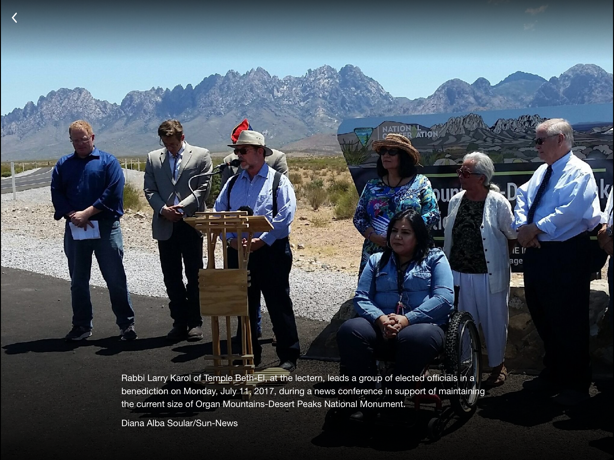
Closing Prayer at Organ Mountains-Desert Peaks Press Conference in support of current monument on July 10, 2017


Eternal God, Creator and Sustainer of us all, 
We thank for you for community.
We thank you for partnership among ourselves and with You
We thank you for this amazing and inspiring place
The beauty that you have placed in the world
The history that has been developed here. 
We are Your partners
We are Your representatives in this world
To preserve what's here
There are some who might say
That You put this world here to use in any way we want to
But we know that to be Your partners
and to be Your representatives on earth means
to act as if the mountains need a voice
the history needs a voice
Every single day
Every single moment.
We have done our best to be that voice
and Eternal One, we ask You to open minds and hearts
of those who may not understand what it means to be stewards
What it means to be Your partners totally. 
So help us in that path
Walk with us, walk with anyone who comes through these mountains,
through the whole monument area
So that they can get a sense of Your work in our world every day, 
continually renewing creation.
Be with us and guide us as we work with each other. 

Saturday, July 8, 2017

L'chulam - A Gift of New Songs from my home studio

So what happens to a singer/songwriter in between and after albums have emerged from recordings in the studio?   
My songwriting of original Jewish music has never stopped since the creation of "Let Me Sing My Way into Your Night" in October, 1999 and "Two are Better Than One" in November, 1999.   Each time I went to the studio, there were several songs that were not included in the recordings, but not because they were less favorite or meaningful to me.   I have now created multi-track recordings of many of these songs in my home studio, using the resources I have available for myself.   At some point, other people's voices and instruments may be added.  For right now, here is what I have done on my own.   All of these tracks are posted on www.reverbnation.com/larrykarol and you can find them there, but here they are with brief introductions and explanations.  As always, it is an honor to share these songs with you! 

THE LINKS FOR THESE SONGS ARE NOW TO A FILE ON DROPBOX SO THAT ANYONE CAN ACCESS THEM FROM A PHONE OR TABLET, AS WELL AS FROM A COMPUTER.   HAPPY LISTENING! 

1) One Voice - created in 2005 as part of a songwriting workshop at Have Nashira led by Craig Taubman, the chorus emerged in response to a request for a sort of Jewish haiku.   The verses were added a few weeks later.   This was intended as a statement of who I am - and it still expresses my sense of self as part of a community. 

2) Lev Tahor (A Pure Heart) - Based on Psalm 51. 

3) Good to Me - This is based on the hopeful message that is contained in Psalm 13, created in February of 2006 to express gratitude for a fruitful 22-year run in Topeka, KS at Temple Beth Sholom.  

4) Eilu V'Eilu-  Jocelyn Segal Tarkoff asked me to come to her Cohen Hillel Academy 3rd Grade class in February 2008 to work on a song that expressed the values of being in a meaningful and productive study partnership.  I wrote the first two verses and the chorus, and the students wrote verse 3 and joined me on the vocals.  This was recorded on my iBook but I still love listening to these wise children add their harmonies.   

5) Turn to Me - Based on Psalm 84, this was a song of reaching out for help and hope.   No one wants to feel alone, the presence of God or supportive friends can guide us through difficult times.  

6) How Good - this was a song created in two stages.  The chorus was premiered at an Interfaith Thanksgiving service in Dover, NH.  The bridge in this song was written for a Martin Luther King, Jr. birthday celebration at the University of New Hampshire.   

7) Remember Us (Ya-aleh V'Yavo) - This song "anglicizes" a prayer recited on the Jewish holidays, and its meaning reaches beyond those special times. 

8) What Peace Is - This was created for the Peace Village of Las Cruces Peace Camp summer program in 2015.    

9) Feel the Blessing - I wanted to write about the Priestly Blessing (May God Bless You and Keep You) but from the perspective of the one giving blessing and the one receiving blessing.    This is what emerged. 

10) House of Prayer - After the shooting at the church in Charleston, South Carolina, I thought about texts that spoke of holy places from the Bible, focusing on the Isaiah Chapter 56 message: "My House shall be called a House of Prayer for all peoples." 

11) Nigun Refuah/Esa Einai - I created this melody during a time of healing for myself in 2005.   The Nigun came first, then I realized that Esa Einai fit the melody.   

12) Asei L'cha Rav - I wrote this to mark the 35th anniversary of my ordination as a rabbi in 2016.  

13) Yosheiv B'Seter Elyon - This song incorporates text from Psalm 91, which is recited at funerals in Jewish tradition and at other times.  I wrote this the day after I wrote Asei L'cha Rav as a response to the attack at the Sarona Market in Tel Aviv on June 9, 2016.  

14) Or Lay'sharim - This song was created in late January, 2017, as a way of generating a sense of resolve and action to reiterate values that we prize in our society and country - and the world. 
Or Lay'sharim (Light of the Upright)

15) Hak'shivah- Listen to My Prayer - Psalm 16 seeks a sense of God's presence, which can be realized when we are present for each other.   It is about companionship, love and hope.   
Hak'shivah (Listen to My Prayer)

16) L'chulam (For Everyone) - The naming ceremony in the Reform movement's Rabbi's manual includes a reading that was part of my rabbinic ordination service based on a quote by Martin Buber, that each of us is here to fulfill our particularity in the world.   I added to the mix a saying of the rabbis that "there is no one who doesn't have his/her time and no thing that does not have its place."   This was written in honor of the impending birth of a grandchild....so Joshua Moise Karol, born on 6/1/2017, this is for you! 
L'chulam (For Everyone)

17) What it Means to Be Free - originally created in 2013 during the push for new immigration legislation, I broadened the message of the song in 2016, and made it multitrack on 7/4/2017.   
What It Means to be Free

18) Owe It All - In 2007, I asked my students at Temple Israel in Dover, NH to say what they were thankful for and, if they were asking God for strength, for what would they make the request.  In 2017, I added comments about peace from the 2016 Las Cruces Peace Camp staff and campers.   
Owe It All

19) Nashirah (Let Us Sing) - I wrote this song soon after a visit to B'nai Jeshurun in New York City.   It is about how music can lead us to joy, soulful expression, gratitude and love.  I added to the original 2005 recording additional vocals in 2017.  
Nashirah (Let Us Sing)

20) Offerings - I have had the honor of setting to music three of Alden Solovy's liturgical poems that inspired me to create a melody tailor to his words.   This is the song which I have recorded with harmonies, with the other two waiting in the wings.   
Offerings (Words by Alden Solovy, Music by Larry Karol)

There are even more songs than these that can/will be shared.  Please listen and enjoy.   That is why this music is here, whether from me or anyone else. 


50 years ago - A Jewish summer camper was "born"

I figure that I should post this at some point.   In late June of 1967, I left home (in Kansas City, Missouri) for the first time to spend 11 days away on my own...well, sort of on my own.  This non-boy scout actually agreed to attend the inaugural session of Tzofim at what was then Olin Sang Union Institute Camp 50 years ago.  After a visit to my congregation from camp director Irv Kaplan, I had tried to sign up for the regular cabin session, Kallah.  After I was notified that it was closed, I was disappointed, but soon a green post card came to my house.  It said that there was a possibility for a tent-based session to be created, which would have the same basic programming as the Kallah session.   I said yes, and so I had my opportunity to get a taste of Jewish summer camping. 
  Full disclosure - I am the one in the front row on the far left in the photo below, it's true.  They did try to teach me to swim, but that didn't take.  Still, it was a great experience. 
      During one of my years at the camp for the Hava Nashira Songleader workshop (around 2003, maybe) we were all sitting in the Bayit, the main building that was near Lac La Belle.    One of the faculty gave us this direction during a service: "Think about the first time you were away from home."   As I sat on my chair in the Bayit, I said to myself my answer to the question.  "Here.   This is THE place where I spent my first time away from home."   I have had contact over the years with a few people in this photo.  I would have never thought that I would have been a part of something like this that was a first.   Tzofim 1967 was full of real Tzofim, because we were the ones who helped the camp "scout out" whether this program would work. And did it ever!  I returned for Tzofim Bet in 1968, and didn't make it back to OSRUI until 1999 for my first Hava Nashira workshop.  The distant memories of Tzofim added very much to my Jewish foundation of learning and connections that have continued during my time at University of Illinois in Champaign-Urbana, at HUC-JIR, and throughout my rabbinate (of 36 years now).  So, thank you, what is now OSRUI, for adding an important dimension to my Jewish life!

Thursday, July 6, 2017

Strong Leadership inspires unity rather than division - Las Cruces Bulletin column - July 7, 2017

    Leadership - and what makes a good leader - has been on my mind for many years.   I have seen members of the congregations I have served assume positions of responsibility and exhibit a wide variety of approaches to fulfilling their responsibilities.   My hope is always that what will result from anyones leadership style is collaboration among members that creates a team spirit and a feeling of unity on many levels. 
      Every week, in synagogues around the world, the same section of the Torah (the first five books in the Bible) is read, explained and discussed.   That means there is ample opportunity to focus on the figure of Moses as a leader of the Israelites.   Recently, we read about the rebellion against Moses (and against his brother, Aaron) that was based on manufactured charges that gave Moses no credit whatsoever for his accomplishments.  That passage in the book of Numbers sees the people accuse Moses and Aaron of being arrogant and out of touch.  It was asserted that they portrayed only themselves as holy, when, according to the rebels, all the people were holy.  In fact, these two brothers were dedicated to the people and doing the best they could to serve a large multitude of individuals with different needs.  In modern terms, we could redefine the holiness of each person in reference to his or her intrinsic significance.  Every person counted.  In Jewish tradition, Moses was known for his humility, so he did value every individual. That made him a better leader.  
     There are aspects of Mosess leadership from which we can learn today.  We see and hear, at times, about too many leaders who believe that it is their mission only to amass power and influence, to impose their will rather than to create partnerships, and to stir up their followers in order to create an us/them framework where life is about conquest rather than compromise.  
    When I seek out a list of the characteristics of a good leader, I usually turn to historian Doris Kearns Goodwins classic summaries of leadership traits based on her studies of presidents from our nations past.  She has noted that successful leaders are good-natured and learn from failure by being humble and persistent so that they can stand up and try again.  Successful leaders surround themselves with people who agree with them and people who may not agree with them in order toarrive at the best decision possible, based on a variety of opinions.    Leaders who are successful inspire those working for them and with them to do their best.  They are able to relax and to replenish their energy.  Successful leaders can cool down and control their emotions.  Leaders are at their best when they learn how to speak to people so that they will listen and feel inspired in a way that creates unity among them rather than division. 
    Hopefully, we see around us leaders who are able to sow seeds of understanding and cooperation, who can seek out the truth and hold up the importance of personal integrity. Sometimes, the ones who live by the highest values, the true heroes, come from among the rank and file of a society.  These are special individuals who are more concerned about doing good than about gaining power.       
    There are many ways to lead, and to follow, but the goal can always be to bring people together in a spirit of unity, beginning with the recognition of their common humanity.   So let us talk, listen, learn, and hope as we continue to guide one another on our journey together.


Friday, June 30, 2017

The Day that the Eternal One has made - Every Day! - Column for Temple Beth-El Las Cruces Adelante Newsletter for July, 2017

ZEH HAYOM ASAH ADONAI - NAGILAH V’NIS’M’CHAH VO - This is the day that the Eternal One has made; let us rejoice and be glad in it.”    This verse from Psalm 118 applies to most any important day in our lives.   Rhonda and I included this text on the invitation to our congregation for our son Adam’s B’rit Milah in March of 1986.   I referred to this verse from Psalms in the eulogy for my mother in May of 2006 to characterize how she approached her life, treating every day as an opportunity to do something special for and make an impact on her community.  
      Rhonda and I witnessed yet another “ZEH HAYOM” event on June 8 at the B’rit Milah of Joshua Moise Karol.  It was important that this tradition continued for yet another generation of our family.   What was also special was that some of the friends and family gathered for this ceremony at Congregation Rodeph Sholom in New York City had also been present at past simchahs for Juli and for Adam.    A photo was taken on June 8 that was similar to one from the wedding weekend in February, 2015 of six of us: Rhonda and me,  Adam and Juli, and Juli’s parents, Steve and Nancie Schnur.  This new picture, however, included one more person who is just beginning his life’s journey.  We hope to see this “young man” grow not only in texted photos and on FaceTime but also in person as much as possible.  
      Recently, while working on a project of locating all of our personal documentation for the renewal of our New Mexico driver’s licenses later this year, Rhonda and I had an opportunity to rediscover and explore the necessary materials stored in their appropriate envelopes.   Not only was there my birth certificate from the State of Missouri, but there was also the Jewish certificate related to my 8th-day ceremony.  My bar mitzvah certificate (from 50 years ago) and Rhonda’s Confirmation certificate from 1970 are still there.  We found our Ohio marriage license from 1982.  Its Jewish counterpart is on our wall, our wedding Ketubah crafted by Dayton, Ohio friend and artist Joan Marcus. 
      Documents - both Jewish and secular - and photographs chronicle our lives.  They illustrate the stories we tell about our own beginnings and upbringing.   Sometimes the documents take on an unusual form.  One day when I was visiting my dad’s brother, Harry, he began talking about family history.   I began writing notes on store receipts that I happened to have in my wallet.   I found those notes again in the last few days.  They recorded stories that my uncle told me that day that I have shared with some of my cousins, including an account of how our ancestors helped one another find their way to America.
     Knowledge of my family history also enabled me to recognize the name of a “real relative” who was identified as one of my “DNA relatives” on a well-known ancestry website (his great-grandmother and my Dad’s mother were sisters).  I wrote him a note to make the connection.  He said of our common ancestors in his response: “I hear they were both very strong women!” 
     In just one sentence, a story was told. An aspect of character was memorialized, one that confirmed what I had heard as well.    Whenever we share these impressions, anecdotes and stories, the past comes alive (whether in families or in congregations) and is preserved so that new tales can be told in the years to come.
     As Rhonda and I each held our new grandson, we had a chance to look him in the eyes and to see him gaze right back.   Perhaps what he sees in our eyes will be something he will articulate later in his life.  What we saw in his eyes was all that he represents: a tribute to the past with his arrival, a source of joy for the present, and beacon of hope for the future.  We wish for him and his parents- as we wish for everyone of any age - many days on which to say, “This is the day that the Eternal One has made; let us rejoice and be glad in it.”  


A Prayer for Softer Words and Sacred harmony among us - Parashat Chukat - June 30, 2017 (on the occasion of completing 6 years at Temple Beth-El of Las Cruces)

Eternal One,
You watch over us every day
In our best times
And in our most challenging times.
You direct us, as much as possible,
To work with each other for good,
To join together to do mitzvot
To engender understanding with each other.
Perhaps You lament, along with us,
When cruelty overtakes cooperation.
When the desire to strike back supersedes the possibility
Of soft speech and words than can lead to healing.
In the Torah reading this week,
We see Moses and Aaron driven to frustration
Forgetting to use only the gentle speech that was required in a crucial moment.
We see the Israelites mourn for Miriam, then Aaron,
Losing one who led them in song
And another who gave them blessing.
May we act in community
As if our voices were joined in sacred harmony
May the ways in which we work with each other
And build long lasting relationships
Bring us blessing and strength.
And may the enmity that leads to division
Give way to the realization
That we have much in common
As we continue along this challenging and eventful human journey.
Be with us every moment,
Inspire us every day.

Amen.